


Best Ecommerce Marketing Agency in 2026: Top 10 Picks
TL;DR
Ecommerce customer acquisition costs have jumped 40 to 60% since 2023, and ROAS is declining across every major ad platform. The best ecommerce marketing agency for your brand depends on three things: where you sell (Amazon, DTC, or both), your revenue stage, and whether you need media buying alone or full growth operations. This guide compares 10 agencies by starting price, specialty, verified reviews, and honest tradeoffs so you can build a shortlist that actually fits.
Why Finding the Right Ecommerce Agency Matters More in 2026
The math has changed. Ecommerce customer acquisition costs rose 40 to 60% between 2023 and 2025, according to data from Ringly, Eightx, and Genesys Growth. DTC brands now face CAC between $68 and $84 per customer, while Amazon CAC runs roughly 50% lower because marketplace demand is already built in. The median CAC across verticals sits at $156, but premium categories like consumer electronics push the average to $242.
Meanwhile, the US direct-to-consumer ecommerce market hit approximately $240 billion in 2025, and roughly 79% of DTC brands now partner with external agencies for at least one marketing function. The brands that aren’t working with agencies are often the ones struggling hardest with rising costs and fragmented execution.
Here’s the problem most brands run into: the agency world is split. You hire an Amazon agency for marketplace growth. You hire a separate DTC agency for Google and Meta. Neither talks to the other. Your data lives in silos. Your ad spend cannibalizes itself across channels. Practitioners on Reddit consistently describe this fragmentation as the single biggest waste of budget for growing CPG brands.
This list evaluates agencies through that lens. Each profile covers services, starting prices, verified reviews, and the honest limitations that most listicles skip.
Looking for a quick assessment of where your brand stands? Get a free brand audit with a scorecard and 90-day action plan.
At-a-Glance Comparison Table
| Agency | Best For | Starting Price | Core Specialty | Reviews/Ratings | Amazon + DTC? |
|---|---|---|---|---|---|
| EZCommerce | Unified Amazon + DTC (SMB to midmarket) | $499/mo | Amazon PPC, Google/Meta, CRO, compliance, inventory | Shopify Partner, Buy with Prime Partner | ✅ Both |
| Nuanced Media | Amazon-centric multichannel | ~$5,000+ per project | Amazon PPC/DSP, ecommerce web | AgencyCluster 100/100; 29 Clutch reviews | Partial (Amazon-first) |
| Canopy Management | Amazon-only ($5M+ brands) | Premium (undisclosed) | Amazon PPC, listing optimization, DSP | 4.4 Trustpilot (110 reviews); 5.0 Clutch | Amazon only |
| Disruptive Advertising | Paid media + lifecycle (mid-market) | $4,000–$6,000/mo | Google, Meta, lifecycle, creative | 365 Clutch reviews | DTC only |
| SmartSites | Accessible Google PPC + web design | ~$1,000/mo | Google Ads, SEO, web design | 1,000+ five-star reviews | DTC-leaning |
| Single Grain | AI-driven SEO + content at scale | Custom | Programmatic SEO, AI-powered ads | Enterprise reference clients | DTC-leaning |
| NP Digital | Enterprise organic + omnichannel | $3,000+/mo | SEO, content ecosystem, paid media | Global recognition | DTC-leaning |
| Thrive | Traditional full-service | Custom | SEO, PPC, web, Amazon | Long track record | Both |
| Sweat Pants Agency | DTC subscription brands ($3M–$100M) | Custom | Meta/Google for subscription DTC | $2B managed revenue claim | DTC only |
| Inflow | Ecommerce CRO specialist | Custom | Conversion rate optimization, paid media | Boutique focus, strong case studies | DTC-leaning |
How to Choose the Best Ecommerce Marketing Agency
Before comparing individual agencies, get clear on what type you actually need. There are three categories.
Amazon-focused agencies specialize in PPC campaign structure, listing optimization, A+ Content, DSP, and marketplace compliance. They understand TACOS, BSR, and the Buy Box. They don’t typically run Google or Meta ads.
DTC-focused agencies manage paid social, Google Shopping, SEO, email/SMS, and conversion rate optimization for your own storefront. They think in terms of ROAS, LTV, and site speed. They rarely touch Amazon.
Unified growth agencies handle both Amazon and DTC under one roof. This matters because paid visibility on Amazon compounds organic rank (which lowers CPC over time), and cross-channel budget allocation requires seeing the whole P&L. If you sell on Amazon and Shopify, two siloed agencies will each optimize their own channel without accounting for the other. You can read more about this in our unified Amazon and DTC playbook.
Questions to Ask Before You Sign
Who does the day-to-day work? The most frequently cited complaint across ecommerce agencies on review platforms is the bait-and-switch: senior strategists run the pitch, then hand your account to junior staff. Ask directly.
What metrics define success? The ROAS-obsessed era is fading. Sophisticated operators have shifted to Marketing Efficiency Ratio (MER) and LTV:CAC ratio. If an agency still sells exclusively on ROAS, they’re a generation behind. Understanding true customer acquisition cost is the foundation.
What’s the contract flexibility? The best agencies offer month-to-month terms or contracts with 30 to 60 day cancellation clauses. Year-long lock-ins with no exit often signal that they retain clients through inertia, not results.
Do they produce creative? Ask whether the agency builds ad creative in-house or requires you to supply it. They should produce it. Creative testing is inseparable from media buying in 2026.
Red Flags
- No case studies with specific metrics (just logos and testimonials)
- ROAS-only reporting with no mention of contribution margin
- No access to your own ad accounts
- Minimum 12-month contracts with punitive exit fees
For brands specifically evaluating Amazon partners, our guide to choosing an Amazon agency covers the marketplace-specific questions worth asking.
The 10 Best Ecommerce Marketing Agencies in 2026
1. EZCommerce
Best for: Unified Amazon + DTC growth for SMB-to-midmarket CPG brands
Starting price: Amazon EzAds from $499/mo; Amazon EzScale from $1,999/mo; D2C EzAds from $999/mo; D2C EzScale from $1,999/mo
EZCommerce is based in Irvine, California and partnered with Amazon Ads, TikTok, Shopify, Google, and Meta. What sets it apart from most agencies on this list is the unified model: Amazon PPC, Google/Meta ads, CRO, compliance, and inventory operations all run under one weekly-governed plan with 90-day cycles.
Key services:
- Intent-based Amazon campaign architecture (brand defense, competitor exact, category phrase, discovery broad) with strict negative sculpting and dayparting
- “Rank and Ads Loop” methodology where paid visibility accelerates organic rank, which compounds into lower CPC over time
- Profit-first planning tied to contribution margin and TACOS, not just ACOS
- D2C growth services including Google Performance Max, Meta Advantage+, and DPA management
- CRO Suite with A/B tests on product detail pages and checkout, targeting CVR lifts in 30 to 45 day cycles
- EzGuard compliance and case management: IP enforcement, listing recovery, FBA reimbursements, chargeback support
- Inventory depth planning with restock schedules, FBA fee audits, and aged inventory alerts
- Clean GTM/GA4/CAPI instrumentation with weekly MMM view through Analision BI dashboards
Tradeoffs:
- Boutique scale means fewer marquee logos compared to agencies with hundreds of case studies
- Focused on Amazon plus the core DTC stack (Shopify, WooCommerce, Google, Meta), so brands needing heavy creative studios or global retail media at massive scale may need a larger network
- D2C pricing tiers could benefit from more granular public detail
Who it fits: Amazon sellers and D2C brands doing $50K+ per month in revenue who want Amazon PPC management, Google/Meta ads, CRO, and compliance/inventory operations unified under one plan, without enterprise pricing.
Request a free brand audit to get a scorecard, quick wins, and a 90-day action plan delivered in about five to seven business days.
2. Nuanced Media
Best for: Amazon-centric multichannel strategy for mid-market brands
Starting price: Projects from $5,000; hourly rate $100–$149
Founded in 2010, Nuanced Media has built a strong reputation as an Amazon-first agency that also supports owned ecommerce channels. They earned a perfect 100/100 score from AgencyCluster’s Top 10 Amazon Marketing ranking, and they offer DSP access without Amazon’s standard $35K minimum spend requirement, which opens up programmatic marketplace advertising to smaller brands.
Key services:
- Full-funnel Amazon PPC management and DSP campaigns
- Marketplace strategy including listing optimization and brand registry support
- Ecommerce website development alongside Amazon operations
- Cross-channel marketing for brands expanding beyond Amazon
Real user perspective: One client testimonial on their Clutch profile states: “After 3 months of working with Nuanced, my profits increased 29% month-over-month.”
Tradeoffs:
- Higher price floor than boutique alternatives, which may price out early-stage sellers
- Some reviews note a multi-agency feel rather than a single dedicated strategist model
- Amazon expertise is the core strength; DTC/Shopify-specific depth is secondary
3. Canopy Management
Best for: Amazon-only brands doing $5M+ in annual revenue
Starting price: Premium (not publicly disclosed)
Austin-based Canopy Management was founded in 2018 and has scaled to a team of 60 to 76 people. They report growing client profit by an average of 87% and maintaining a 98% client retention rate. Their $3.21 billion managed revenue figure is cumulative over 8+ years. Canopy earned a 5.0 Clutch rating and an Inc. 500 listing.
Key services:
- Amazon PPC management and campaign optimization
- Listing optimization and A+ Content creation
- Amazon DSP for upper-funnel brand awareness
- Keyword research and competitor analysis specific to Amazon’s algorithm
Real user perspective: Their Trustpilot profile shows a 4.4 out of 5 across 110 reviews. However, recurring complaints mention templated strategies, slower-than-expected communication, and pricing that feels high for mid-size brands. This matches a broader pattern where large Amazon agencies prioritize their biggest accounts.
Tradeoffs:
- Amazon only, so brands selling on Shopify or DTC channels need a second agency
- Undisclosed pricing creates friction during the evaluation phase
- Some reviews report minimum contract terms that limit flexibility
4. Disruptive Advertising
Best for: Mid-market paid media (Google + Meta) with creative bundled in
Starting price: $4,000–$6,000/mo for accounts spending $10,000–$25,000/mo on ads
Founded in 2012 and headquartered in Pleasant Grove, Utah, Disruptive has scaled to several hundred employees and works primarily with mid-market and enterprise brands. They offer no long-term contracts, which is a genuine differentiator in this space.
Key services:
- Google Ads and Meta Ads management
- Lifecycle marketing (email/SMS)
- Creative production for ad campaigns
- Landing page design and conversion optimization
Real results: Client case studies include a 10% year-over-year reduction in cost-per-opportunity and a 33% increase in ecommerce sales.
Real user perspective: One DesignRush reviewer noted: “If you are a small to mid-sized brand I would think twice. I believe they are better suited for big brands with really big budgets.” The most frequent complaints in reviews center on account manager turnover, junior team members managing accounts after senior strategists close the sale, and performance plateaus after the first few months.
Tradeoffs:
- No Amazon marketplace capability, so you’ll need a separate agency for that
- Account manager turnover is a documented pattern across reviews
- Best suited for brands with significant ad budgets, not early-stage operations
5. SmartSites
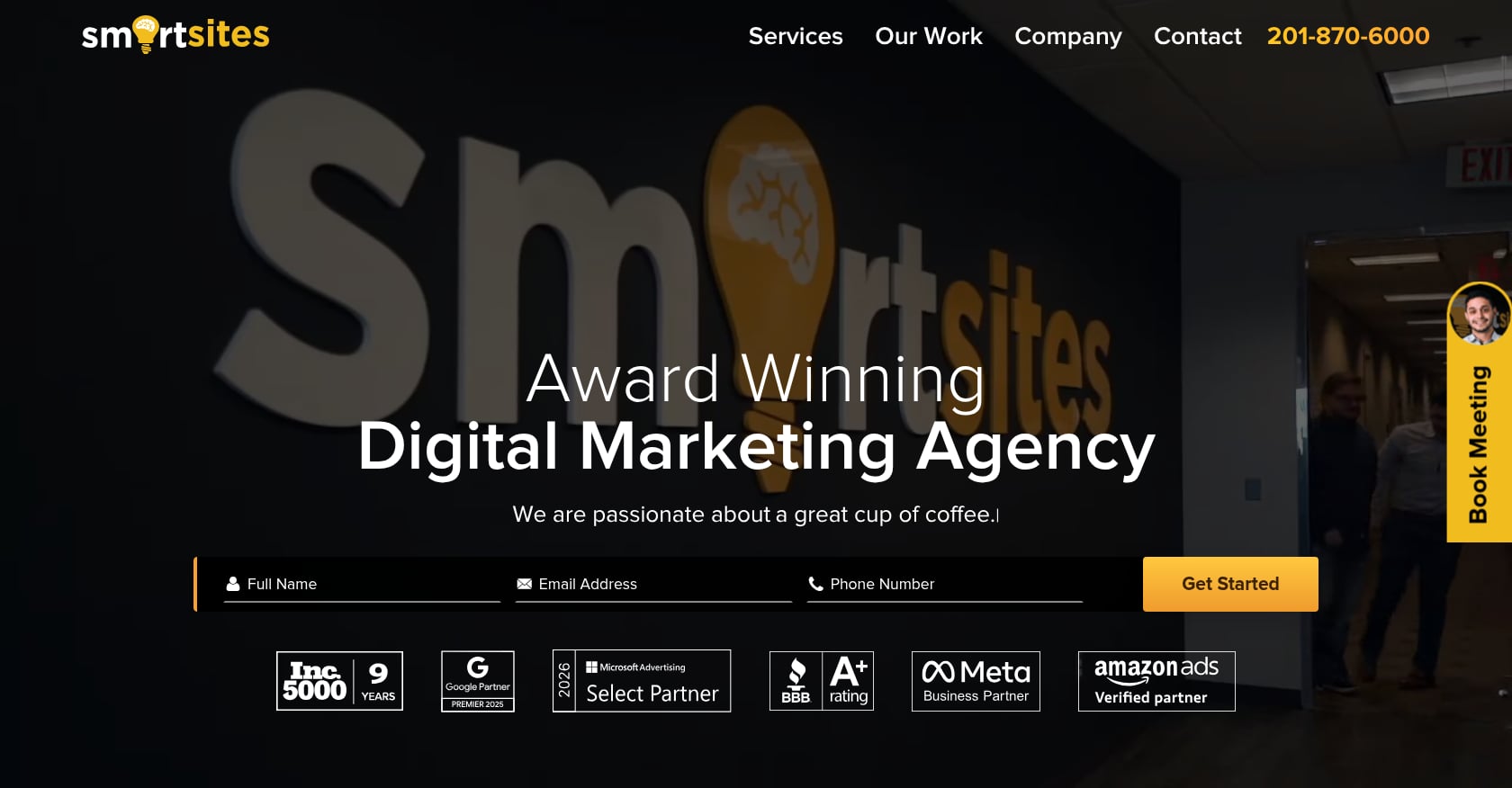
Best for: Accessible Google Shopping and PPC management for SMBs
Starting price: ~$1,000/mo for Google Ads management
SmartSites has earned recognition as a nine-time Inc. 5000 fastest-growing company (2017 to 2025) and accumulated more than 1,000 five-star reviews across platforms. With 300+ verified Clutch reviews and a 100% recommendation rate, they represent one of the most reviewed agencies in the space.
Key services:
- Google Ads management including Shopping campaigns
- SEO for ecommerce sites
- Website design and development
- PPC across multiple platforms
Real user perspective: Clients cite examples of 25x ROI on Google Ads campaigns, though these results vary significantly by vertical and budget.
Tradeoffs:
- Generalist breadth (they work across every vertical) means less ecommerce-specific or Amazon-specific expertise than dedicated agencies
- Lower entry pricing attracts a wide range of clients, which can mean less customized strategy
- Not positioned for brands needing marketplace management or inventory operations
6. Single Grain
Best for: AI-driven SEO and programmatic content at scale
Starting price: Custom (not publicly disclosed)
Led by marketer Eric Siu, Single Grain has evolved into what they describe as an ecommerce growth laboratory, with heavy investment in AI-powered strategies and programmatic SEO. They’ve worked with Amazon, Uber, Nordstrom, and Salesforce.
Key services:
- Programmatic SEO (auto-generated, optimized landing pages at scale)
- AI-powered ad campaign management
- Content marketing strategy
- Paid media across Google and Meta
Real results: One client saw a 340% organic traffic increase within nine months from programmatic SEO implementation.
Tradeoffs:
- Stronger on SEO and content than hands-on marketplace management
- AI-driven approach may not suit brands wanting high-touch, human-led strategy
- Pricing opacity makes budgeting difficult before initial consultation
7. NP Digital
Best for: Enterprise-level organic growth and omnichannel strategy
Starting price: $3,000+/mo with multiple service tiers
Founded by Neil Patel, NP Digital operates globally with offices across North America, Europe, and APAC. They serve mid-market to enterprise brands with an SEO-first approach that extends into paid media and content ecosystems.
Key services:
- Technical and on-page SEO
- Programmatic SEO for large product catalogs
- Content strategy and production
- Paid media management (Google, Meta)
Real results: Ecommerce clients report 200 to 400% organic traffic growth within 12 months through their programmatic SEO methodology.
Tradeoffs:
- Less hands-on for Amazon-specific execution; marketplace management is not their core
- SEO-forward bias may not suit brands needing immediate paid media returns
- Enterprise pricing and enterprise timelines may not fit SMB budgets or urgency
8. Thrive Internet Marketing Agency
Best for: Traditional full-service digital marketing with a long track record
Starting price: Custom (varies by service bundle)
Thrive is a full-service digital marketing firm headquartered in Arlington, Texas, with a growing presence across the US. They’ve been operating since 2005, which gives them one of the longest track records on this list.
Key services:
- SEO, PPC, and social media marketing
- Web design and development
- Amazon marketing services
- Content writing and video production
- Proprietary Thrive Score tool using a 1 to 100 scoring matrix across 150+ factors
Tradeoffs:
- Scale and breadth can mean less specialized depth in any single channel compared to focused boutiques
- Amazon offering exists but is not their primary identity
- Custom pricing means no upfront budget clarity without a sales conversation
9. Sweat Pants Agency
Best for: DTC subscription brands doing $3M–$100M in revenue
Starting price: Custom
Sweat Pants Agency focuses specifically on DTC subscription and repeat-purchase brands. They claim over $2 billion in managed revenue and position themselves as specialists in Meta and Google advertising for consumer brands with strong retention economics.
Key services:
- Meta and Google ad buying for DTC brands
- Creative strategy and production
- Landing page and funnel optimization
- Subscription-specific growth tactics
Tradeoffs:
- DTC only, with no Amazon marketplace capability
- Focused on brands already at $3M+ in revenue, so not suited for early-stage companies
- Smaller public review footprint compared to agencies like Disruptive or SmartSites
10. Inflow
Best for: Ecommerce conversion rate optimization
Starting price: Custom
Inflow positions itself as a CRO and paid media specialist for ecommerce brands. They focus on improving what happens after the click, making them a strong complement to traffic-focused agencies, or a primary partner for brands whose traffic is healthy but conversion rates lag behind the global average of 1.9 to 2%.
Key services:
- Conversion rate optimization through systematic A/B testing
- Paid search and social advertising
- SEO for ecommerce product pages
- Analytics and data strategy
Tradeoffs:
- Boutique team means capacity limitations for very large accounts
- No Amazon marketplace services
- CRO expertise is excellent, but brands needing full-stack marketing (creative, email, marketplace) will need additional partners
For brands that want CRO embedded within a broader growth system rather than as a standalone service, running A/B tests across PDPs and checkout explains what a practical testing program looks like.
What the Best Ecommerce Marketing Agencies Measure in 2026
The metrics that define a strong agency have shifted. The best ecommerce marketing agencies in 2026 have moved beyond ROAS as their headline number and toward business-level metrics: Marketing Efficiency Ratio (MER), contribution margin, and Customer Lifetime Value (LTV:CAC ratio).
Why? Because ROAS can look great while profit is negative. An agency can report a 5x ROAS on Meta while ignoring that your blended CAC, when you factor in Amazon spend, returns, and fulfillment costs, is eating your margin.
Agencies worth hiring in 2026 should demonstrate competency in three areas:
First-party data infrastructure. With third-party cookies continuing to erode, clean GTM/GA4 implementation and Conversions API setup are non-negotiable. If your agency can’t instrument tracking properly, every optimization decision downstream is built on bad data.
Inventory and compliance as marketing functions. This is counterintuitive, but stockouts kill your Amazon BSR and force you to restart paid campaigns from scratch. Suspended listings kill revenue overnight. The agencies that treat inventory depth planning and compliance monitoring as part of their marketing scope are the ones protecting your growth, not just generating clicks.
Attribution across channels. Brands selling on Amazon and DTC need a weekly view of how spend on one channel affects the other. Media mix modeling (even simplified versions) beats last-click attribution for budget allocation decisions.
Amazon + DTC: Why Unified Execution Beats Siloed Agencies
Most brands discover this the hard way. They hire an Amazon agency that optimizes ACOS beautifully. They hire a DTC agency that drives strong Google Shopping returns. But nobody is watching the overlap. Both agencies bid on branded terms. Customers see Amazon and Shopify listings competing against each other in search results. Budget allocation is a guessing game because neither team has visibility into the other’s data.
The concept behind unified execution is straightforward. On Amazon, paid visibility through Sponsored Products and Sponsored Brands drives sales velocity, which improves organic rank, which means you need less ad spend to maintain position. This “rank and ads loop” compounds over time. On the DTC side, Google and Meta campaigns drive traffic to your own storefront where you control margin and customer data.
When one team manages both, they can shift budget toward whichever channel offers better marginal returns in a given week. They can run brand defense campaigns on Amazon while simultaneously pushing acquisition through Meta. They can spot when Amazon cannibalization is hurting DTC margins and adjust.
This isn’t theoretical. The 40 to 60% rise in CAC means that brands can no longer afford to pay two agencies who each optimize in isolation. The savings from eliminating channel overlap alone can cover the cost difference.
Ecommerce Agency Pricing: What to Actually Expect
Pricing is the most requested piece of information in this category, and the one most agencies work hardest to hide. Here’s what the market looks like.
SMB retainers (brands doing under $1M annually) typically range from $1,000 to $5,000 per month. At this level, you’re usually getting one channel managed (Google Ads or Amazon PPC) with limited strategic input.
Mid-market retainers (brands doing $1M to $10M) run $5,000 to $15,000 per month. This is where you start getting multi-channel management, creative production, and more senior attention.
Enterprise retainers ($10M+) range from $12,000 to $25,000+ per month and typically include dedicated teams, custom reporting, and strategic consulting.
Performance-based models are also common. Ecommerce agencies often take 5 to 15% of new revenue generated. A store doing $100,000 per month might pay $5,000 to $15,000 monthly plus performance bonuses.
For a more detailed breakdown of what Amazon-specific management costs, our Amazon account management pricing guide covers the common structures and what you should get at each tier.
The key principle: cheaper is not always better, but expensive is not always justified. Match your budget to your bottleneck. If your Amazon campaigns are hemorrhaging money on irrelevant queries, fixing negative keyword sculpting will deliver more ROI than adding another channel.
Frequently Asked Questions
What does an ecommerce marketing agency actually do?
An ecommerce marketing agency manages the channels, campaigns, and operations that drive online sales. This can include Amazon PPC and marketplace management, Google and Meta advertising, SEO, email/SMS marketing, conversion rate optimization, creative production, and analytics. Some agencies also handle operational functions like inventory planning, compliance monitoring, and listing recovery. The scope depends on whether you hire a specialist (one channel) or a full-service partner.
How much does an ecommerce marketing agency cost?
Monthly retainers for SMBs typically start between $1,000 and $5,000. Mid-market brands should expect $5,000 to $15,000 per month, and enterprise accounts commonly pay $12,000 to $25,000+. Some agencies use performance-based models, charging 5 to 15% of revenue generated. Entry points vary widely: SmartSites starts around $1,000/month, EZCommerce’s Amazon EzAds starts at $499/month, and Disruptive Advertising begins at $4,000 to $6,000/month.
Should I hire an Amazon agency, a DTC agency, or one that does both?
If you sell exclusively on Amazon, an Amazon-focused agency makes sense. If you only sell through your own Shopify or WooCommerce store, a DTC agency is the fit. But if you sell on both (which most growing CPG brands do), a unified agency eliminates the budget overlap, data silos, and cross-channel cannibalization that come from running two separate partners.
What’s the difference between ROAS and MER, and why does it matter?
ROAS (Return on Ad Spend) measures revenue generated per dollar spent on a specific campaign or channel. MER (Marketing Efficiency Ratio) measures total revenue divided by total marketing spend across all channels. MER gives you a clearer picture of overall efficiency because it accounts for channel interactions and prevents individual agencies from claiming credit for the same sale. The best agencies in 2026 report on both.
What are the biggest red flags when evaluating ecommerce agencies?
Long-term contracts with no exit clause, reporting that only shows ROAS without contribution margin, no access to your own ad accounts, and case studies that show logos but no specific metrics. The biggest practical red flag, according to patterns across review platforms, is account manager turnover: senior strategists close the deal, then junior staff handle day-to-day work.
How long does it take to see results from an ecommerce marketing agency?
Most agencies structure work in 90-day cycles. Initial optimizations (fixing campaign structure, negative keywords, listing quality) can show results within 30 to 60 days. Meaningful organic rank improvements on Amazon typically take three to six months of consistent effort. DTC campaigns on Google and Meta usually stabilize within 60 to 90 days as algorithms exit learning phases and creative testing matures.
Do I need a separate CRO agency?
Not necessarily. If your traffic is healthy but conversion rates fall below the global ecommerce average of 1.9 to 2%, CRO should be a priority. Some full-service ecommerce agencies include CRO (A/B testing on product pages and checkout) within their retainer. Others don’t. Ask specifically whether CRO is included or requires a separate engagement. Fixing conversion before scaling traffic is almost always the higher-ROI move.
Can a small brand afford an ecommerce marketing agency?
Yes. Entry-level services start as low as $499 per month for focused Amazon PPC management. The key is matching scope to budget. A small brand shouldn’t pay for enterprise-level services they can’t fully utilize. Start with the channel that represents your biggest bottleneck, get it profitable, then expand. Most agencies offer tiered plans designed for this kind of staged growth.
Choosing the best ecommerce marketing agency comes down to matching your specific bottleneck (marketplace, DTC, or both) with the right expertise and pricing tier. Skip the agencies that hide their prices, lock you into long contracts, and report only vanity metrics.
If you’re selling on Amazon and DTC and want to see where the gaps are, request a free brand audit from EZCommerce. You’ll get a scorecard, quick wins, and a 90-day action plan, with no obligation.