


Top 8 DTC Marketing Agencies in 2026: Pricing & Use Cases
TL;DR
DTC marketing now requires more than running Meta ads to a Shopify store. Rising acquisition costs, fragmented channels, and noisy attribution make choosing the right agency a high-stakes decision. This guide compares eight DTC marketing agencies by pricing, growth bottleneck fit, honest tradeoffs, and real user sentiment so you can match your biggest constraint to the right partner.
DTC Marketing Has Changed. Your Agency Search Should Too.
DTC marketing means selling directly to consumers, bypassing retailers, to gain control over branding, customer data, and margins. That definition from Shopify’s enterprise guide still holds. But the execution has become far more complex.
U.S. direct-to-consumer ecommerce sales were estimated at $239.75 billion in 2025, making up 19.2% of total retail ecommerce sales source. The channel is not disappearing. It is, however, getting harder to run profitably.
A Digiday and Klaviyo survey of 134 brands and agencies found that DTC teams are operating in a leaner, more ROI-focused environment as acquisition costs rise source. The most important KPIs? Conversion rate (75% of respondents), customer acquisition cost (63%), and customer lifetime value (54%).
If you are searching for a DTC marketing agency, you probably already know all this. What you need is a way to compare partners by what actually matters: which growth bottleneck they solve, what they charge, what they include, and where they fall short.
Not sure where your growth is leaking? A free ecommerce brand audit can identify gaps across Amazon, Shopify, paid media, CRO, and tracking before you commit to any agency.
At-a-Glance Comparison Table
| Agency | Best For | Pricing Signal | Key Differentiator | User Sentiment | Main Tradeoff |
|---|---|---|---|---|---|
| EZCommerce | Amazon + D2C brands needing profit-first growth | Amazon EzAds from $499/mo; D2C EzAds from $999/mo; EzScale from $1,999/mo | Unified Amazon + Google/Meta + Shopify/WooCommerce + CRO + analytics + compliance | Client testimonials; Shopify Partner and Amazon Buy with Prime partner | Boutique scale; fewer public case studies than large agencies |
| Top Growth Marketing | Ecommerce paid media + email/SMS retention | $5,000+ min project; $150-$199/hr | Paid + email + social ecommerce focus | Clutch: 4.9 from 18 reviews | Less suited for deep marketplace operations |
| Y’all | Performance creative + paid acquisition | $10K-$25K min budget; $200/hr | DTC creative testing velocity | Reviews praise ROAS jumps and responsiveness | Higher budget floor; not an Amazon ops partner |
| Common Thread Collective | Larger ecommerce growth and paid social | $5K+ min; investments $15K-$350K+ | Known ecommerce paid-social growth partner | Clutch: 4.1 from 17 reviews; mixed feedback | Cost/value perception varies by client |
| Tribe | Shopify Plus CPG and subscription brands | Contact for pricing | CPG, subscription, Shopify expertise | 5.0 from 7 Shopify Partner reviews | Shopify/CPG focused; limited marketplace fit |
| Intero Digital | Enterprise full-service search, paid, Amazon, AI search | $1K+ min; common projects $10K-$49K | Large agency breadth including AI search | Clutch: 4.8 from 147 reviews | Quality may vary by team; includes serious negative review |
| DTC Pages | CRO, landing pages, AI-shopping readiness | Verify full pricing; profile lists services from $49/$99 | CRO + agentic commerce/GEO focus | Profile cites 4.5 Trustpilot rating | Specialist CRO layer, not full-stack growth |
| eCommerce Today | Shopify Plus execution on accessible budgets | $1,125-$12,000/year depending on scope | Shopify Plus development + PPC/SEO | 53 Clutch reviews | May be scoped support rather than full DTC strategy |
How to Choose a DTC Marketing Agency
Most agency comparison pages list providers by service menu: paid media, SEO, CRO, email, creative. That is not very useful because nearly every agency claims to do all of those things.
A better approach is to identify your bottleneck first, then match it to an agency whose strength directly addresses that problem.
CAC rising fast: You need creative testing velocity and contribution-margin discipline, not just more spend. Practitioners on LinkedIn report that CAC has climbed 40-60% across verticals since 2023, and some argue that creative refresh cycles should happen every 10-14 days for brands hitting strong ROAS, not the more common 4-6 week cadence.
Traffic exists but revenue is weak: This points to CRO, product page clarity, and checkout friction. Baymard Institute reports a global average cart abandonment rate of 70.19% and estimates that large ecommerce sites can gain a 35% conversion-rate increase through better checkout UX source. Before increasing ad budgets, it is worth testing checkout conversion improvements and product page changes.
Good first orders but bad profit: You need retention strategy, LTV analysis, bundle/offer testing, and honest cohort economics. One DTC founder on Reddit described the core problem clearly: first-order ads looked fine in-platform, but cohort contribution margin and flat 60-90 day repeat purchase rates showed the business was only buying one-time customers source.
Amazon rank stagnating: You need Amazon PPC architecture, listing quality, inventory depth, and TACOS discipline, not just a bigger Sponsored Products budget.
Attribution is broken: Without clean GA4, Meta CAPI, and server-side tracking, budget allocation becomes guesswork. Meta positions its Conversions API as a direct, more reliable connection between server and platform data for better measurement source. Google’s Performance Max retail documentation emphasizes product-feed structure and asset-group segmentation source. If your agency cannot explain how your tracking implementation works, that is a problem.
Scaling chaos: You need governance cadence, inventory planning, 3PL coordination, and weekly financial visibility across channels.
A Reddit thread on ecommerce agency recommendations made a useful point: many agencies offer the same SEO, PPC, and CRO menu, and a better question is how many net-new creative concepts they test per month and how quickly they iterate winners source.
How Much Does DTC Marketing Cost?
Pricing transparency is rare in this space, so here is what the data shows.
MarketerHire’s 2026 DTC agency guide reports that retainers commonly run $6,000-$25,000+ per month, with many mid-stage brands landing between $10,000 and $18,000. High-spend accounts may add 5-15% of managed ad spend on top of the retainer source.
EZCommerce publishes starting prices directly: Amazon EzAds from $499/month, D2C EzAds from $999/month, and EzScale tiers starting at $1,999/month.
But the retainer is never the full cost. Brands should budget for:
- Media spend (separate from retainer)
- Creative production
- Email/SMS platform fees (Klaviyo, etc.)
- Attribution and analytics software
- Landing page and CRO testing tools
- Influencer or UGC seeding
- Amazon compliance and reimbursement support
- Inventory financing or 3PL costs
- Shopify app stack
Some of these are included in full-service retainers. Many are not. Always ask what is inside the retainer versus billed separately.
8 Best DTC Marketing Agencies
1. EZCommerce
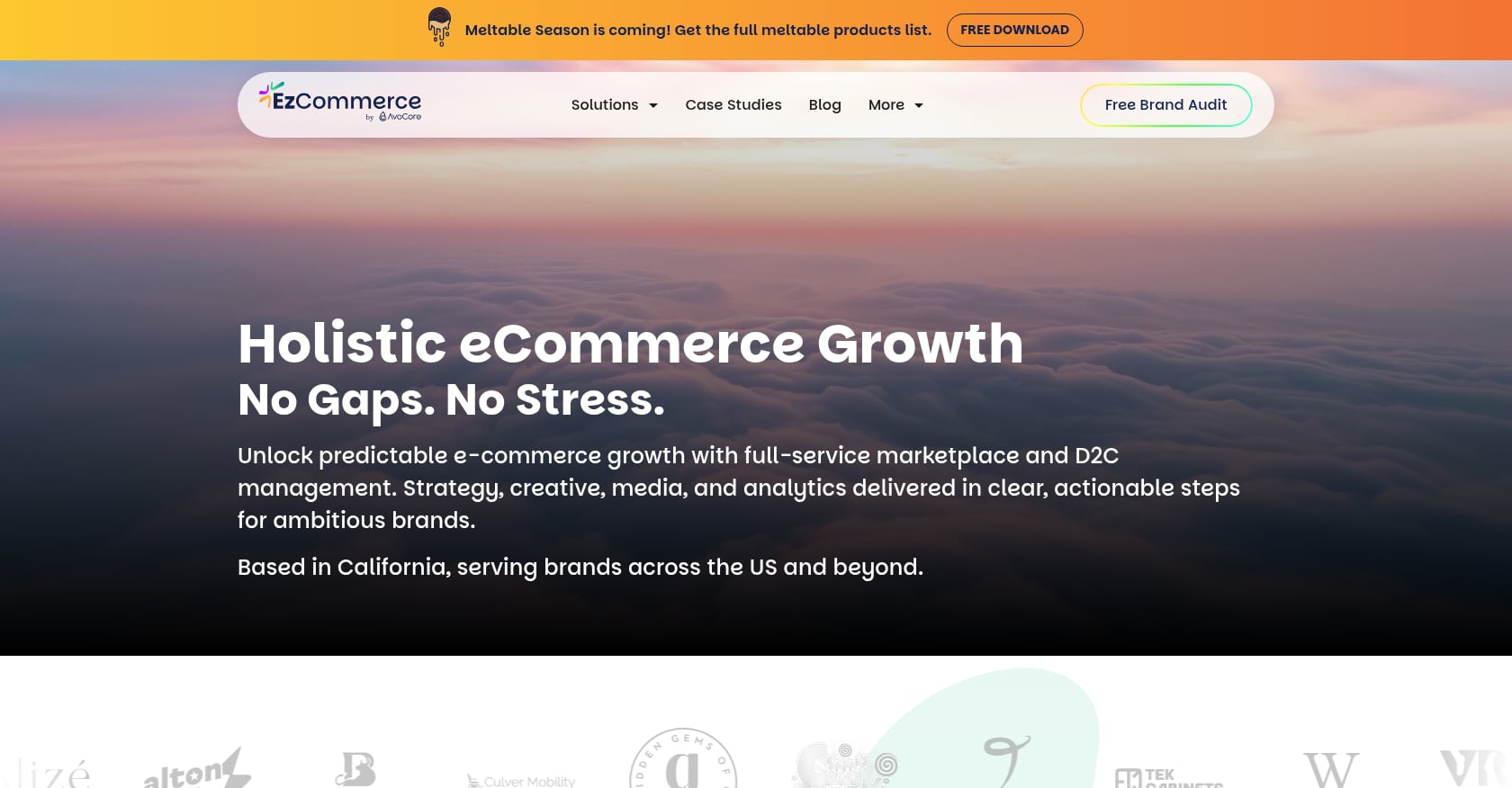
Best for: DTC and marketplace brands that need Amazon, Shopify/WooCommerce, Google, Meta, CRO, analytics, inventory planning, and compliance managed under one profit-first growth plan.
Pricing:
- Amazon EzAds starts at $499/month
- Amazon EzScale starts at $1,999/month per Amazon account
- D2C EzAds starts at $999/month
- D2C EzScale starts at $1,999/month
- Free eCommerce Brand Audit available
Key features:
- Intent-based Amazon campaign architecture: brand defense, competitor exact, category phrase, discovery broad, strict negatives, dayparting, and placement controls
- “Rank and Ads Loop” methodology that uses paid visibility to accelerate organic rank, reducing CPC over time
- Amazon listing optimization including titles, bullets, imagery, A+ Content, and Brand Store
- Inventory depth planning with restock schedules, FBA fee audits, and aged inventory alerts
- EzGuard case management: monitoring, listing/account recovery, IP enforcement, reimbursements
- D2C paid media across Google and Meta with clean GTM, GA4, and CAPI tracking
- CRO Suite: A/B tests on PDPs and checkout, offers, upsells/bundles, popups, UX speed
- Analytics dashboards with weekly MMM view covering LTV, CAC, ROAS, and margin
- Optional 24/7 customer service across email, chat, social, and phone
- 90-day growth plans with weekly/biweekly governance cadence
User sentiment: Client testimonials from brands including Tayfus, Garisar, VRD Socks, and W Kitchen & Bath are featured on site. Listed in the Shopify Partner Directory and Amazon Buy with Prime Agency Partner directory. Clutch and DesignRush profiles exist. No verified third-party Reddit or forum discussions specific to EZCommerce were found.
Tradeoffs:
- Boutique scale with fewer public case studies than larger agencies
- Some D2C pricing labels may need sales confirmation for specific scopes
- Brands needing a massive creative studio or global retail media at scale may prefer larger networks
Who should choose it: Brands selling on both Amazon and Shopify/WooCommerce that want one team managing paid media, CRO, analytics, inventory, and compliance with margin discipline. The unified approach directly addresses what most DTC agency lists miss: the reality that Amazon and DTC channels affect each other. Stockouts on Amazon hurt rank. Weak Amazon listings hurt brand trust even when your Shopify store is strong. And siloed reporting hides where profit is actually leaking.
Explore the full Amazon services suite or the D2C growth system for detailed service breakdowns.
Who should skip it: Brands that only need a standalone creative production house or a wholesale/retail accelerator model.
2. Top Growth Marketing
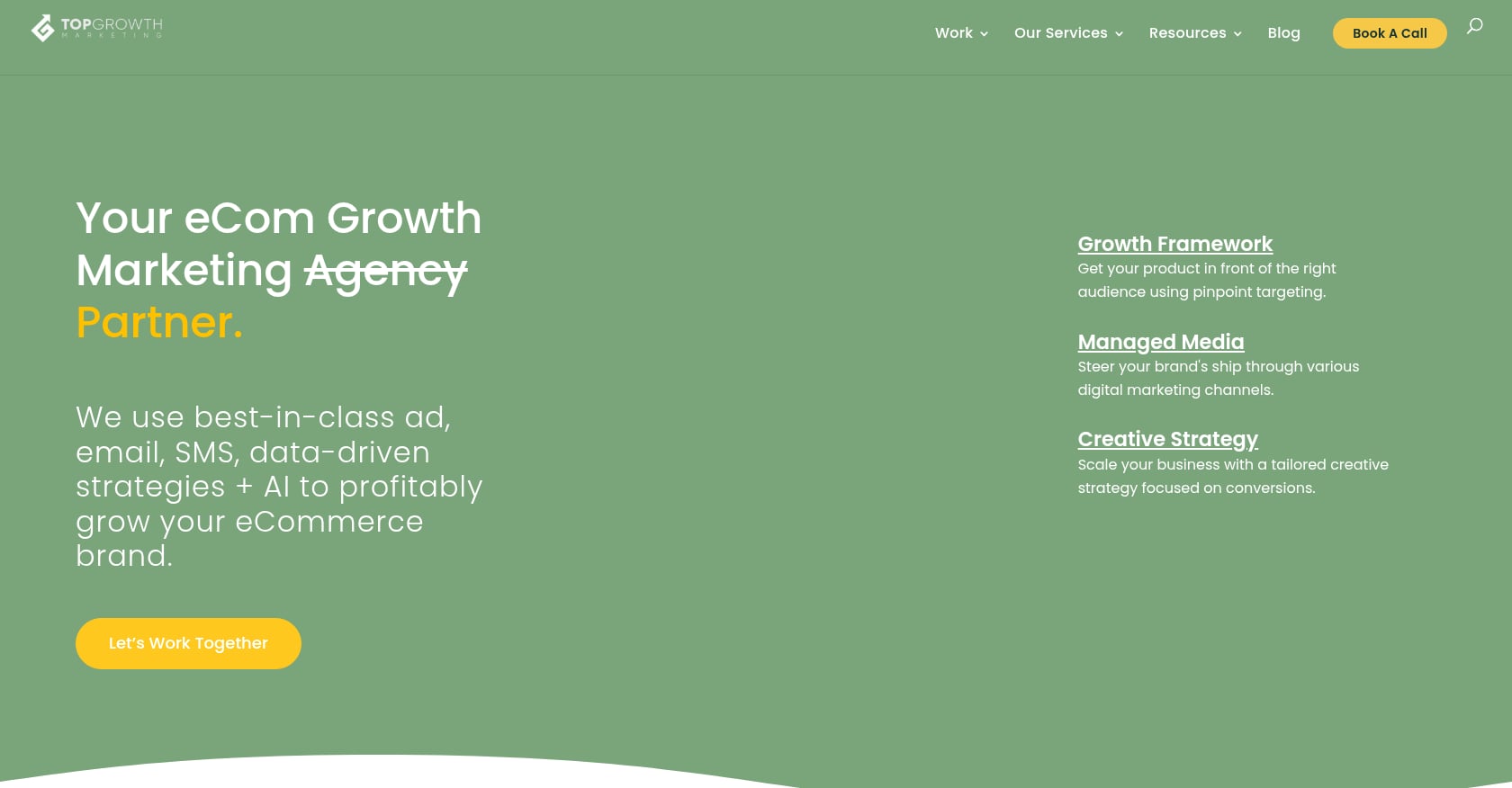
Best for: DTC brands focused primarily on paid media performance and Klaviyo-driven email/SMS retention.
Pricing: Clutch lists a $5,000+ minimum project size and $150-$199/hour average hourly rate source.
Key features:
- Ecommerce marketing across Google, Facebook, and Instagram Ads
- Email marketing (Klaviyo focus)
- PPC management
- Social media marketing
User sentiment: Clutch rates them 4.9 across 18 reviews, with clients praising improvements in online sales, conversion rates, and ROAS. Some clients suggested the agency expand into additional channels like DSPs or AI-based offerings source.
Tradeoffs:
- Less suited for brands needing deep Amazon account health work, marketplace compliance, or inventory planning
- Total costs may exceed smaller SMB budgets once media spend, creative, and platform fees are included
- Service breadth is narrower than full-service ecommerce partners
Who should choose it: Brands whose primary bottleneck is paid acquisition and email/SMS monetization, and who manage Amazon separately or not at all.
3. Y’all
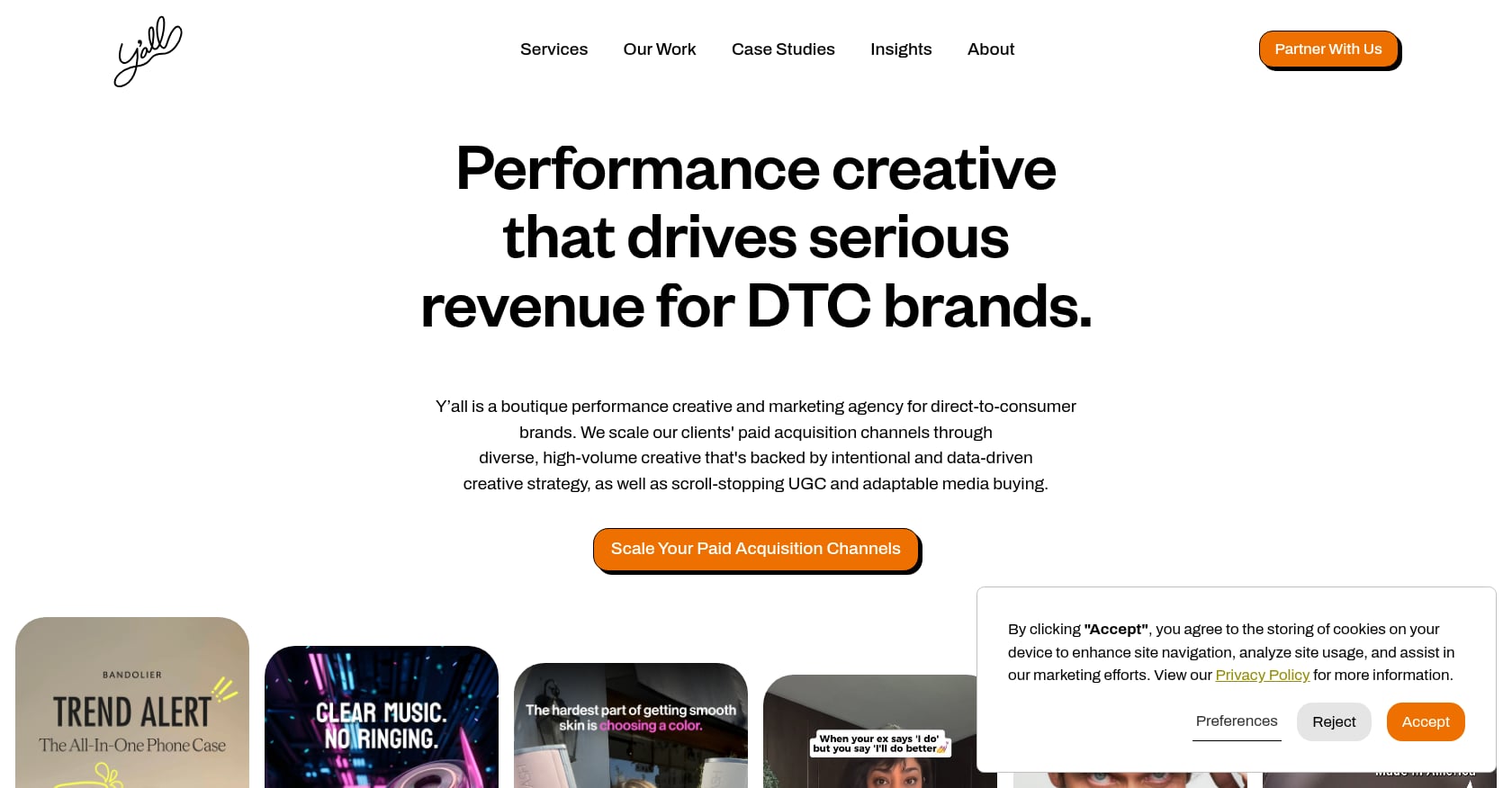
Best for: DTC brands that need stronger creative testing and performance creative across Meta, TikTok, Google, and YouTube.
Pricing: DesignRush lists a $10,000-$25,000 minimum budget and $200/hour average hourly rate source.
Key features:
- Digital marketing and media buying
- Performance creative services
- CRO and ecommerce optimization
- DTC marketing, growth marketing, and Shopify marketing expertise
User sentiment: A cosmetics client reported a 184.6% ROAS jump after Y’all audited and restructured Meta and Google campaigns. A consumer goods client praised their responsiveness during busy seasons. A wellness beverage reviewer praised positive ROAS but wanted more reporting visibility into tests and strategy direction source.
Tradeoffs:
- Higher budget floor than SMB-friendly providers
- Strong creative/paid fit, but does not cover Amazon compliance, inventory planning, or marketplace operations
- Reporting transparency was flagged by at least one reviewer
Who should choose it: Brands with creative fatigue driving up CAC, who need an agency that tests concepts rapidly and iterates winners. Practitioners on Reddit and LinkedIn consistently point to creative testing velocity as a real differentiator when evaluating DTC marketing agencies. One LinkedIn practitioner claimed many DTC brands lack a formal creative testing process and rely on outdated content-pillar planning, leading to too few variations and slow learning cycles. For brands thinking about building a CRO and creative testing roadmap, creative throughput should be a key evaluation criterion.
4. Common Thread Collective
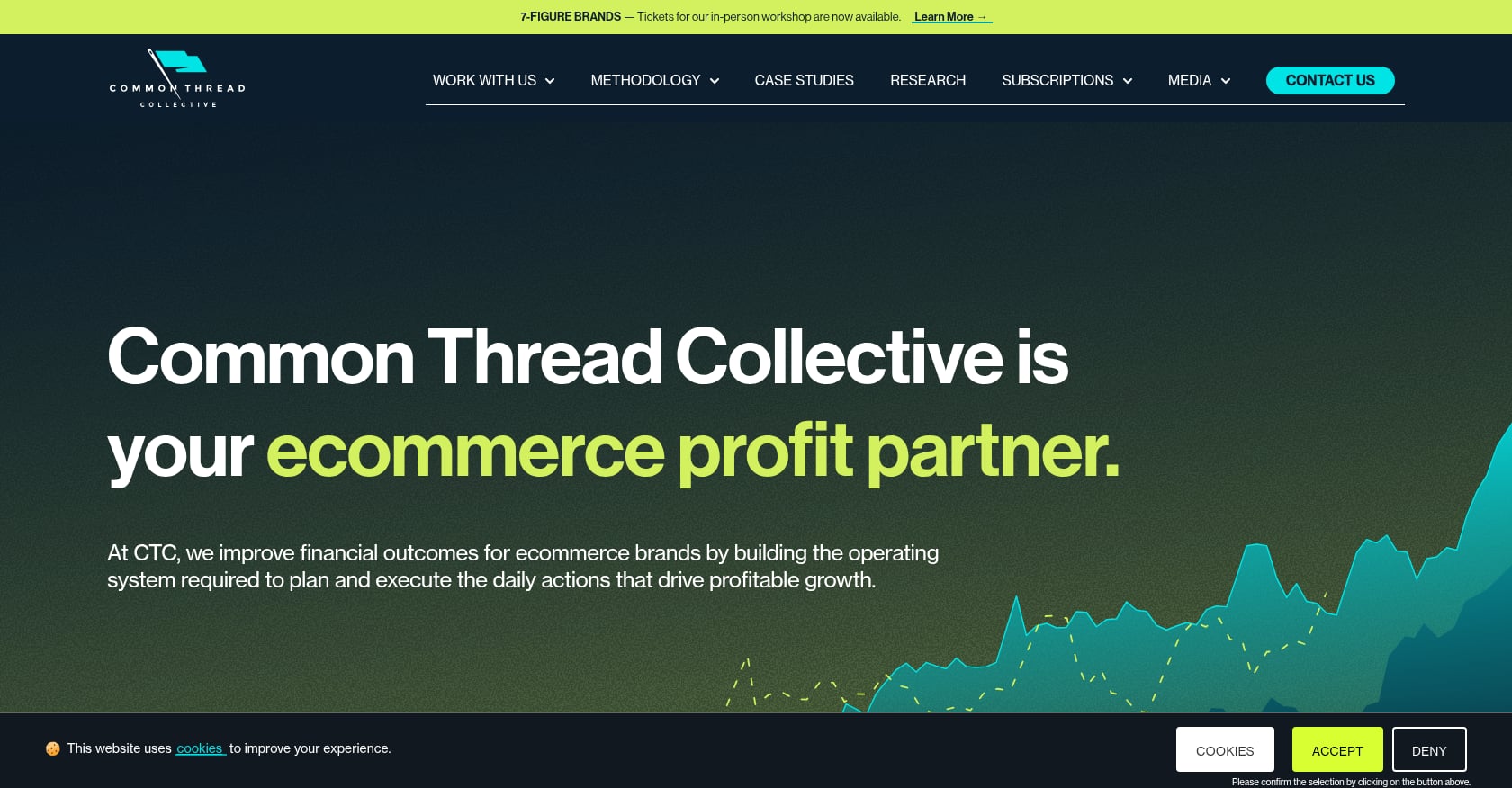
Best for: Established ecommerce brands that want a recognized growth partner for paid social, creative, conversion optimization, and strategy.
Pricing: Clutch lists a $5,000+ minimum project size, $150-$199/hour, and client investments ranging from $15,000 to over $350,000 source.
Key features:
- Social media marketing
- Branding and video production
- Conversion optimization
- Web design
User sentiment: Positive reviews cite Facebook and Instagram expertise and revenue growth. One ecommerce client described “amazing Facebook industry knowledge.” However, a skincare client review said the agency did not deliver above-average results and that more traffic did not translate into profits source. The Clutch rating sits at 4.1 across 17 reviews, with cost receiving a 3.9/5 score.
Tradeoffs:
- More mixed review profile than some alternatives
- Cost/value perception varies significantly by client
- Better fit for brands with enough budget and internal sophistication to manage a larger agency relationship
- Not positioned for Amazon PPC, marketplace compliance, or inventory coordination
Who should choose it: Larger DTC brands with substantial paid social budgets that want a name-brand agency partner. Buyer should vet category-specific case studies and ask for references at a similar revenue stage.
5. Tribe

Best for: Shopify Plus brands in food, drink, beauty, wellness, and CPG that need store design, subscription strategy, and retention-focused ecommerce growth.
Pricing: Shopify’s Partner Directory lists Tribe as contact for pricing source.
Key features:
- Shopify Plus website builds and redesigns
- Subscription strategy for CPG brands
- Creative, strategy, and technical Shopify expertise
- Retention-focused growth
User sentiment: Rated 5.0 from 7 reviews in the Shopify Partner Directory. Review count is limited, so the rating should be treated cautiously.
Tradeoffs:
- Pricing is not public
- Narrower focus on Shopify Plus CPG and subscription, which limits relevance for brands needing Amazon PPC, marketplace compliance, or multi-channel governance
- Smaller review sample than generalist agencies
Who should choose it: Shopify Plus CPG brands where subscription mechanics, repeat purchase rate, and storefront quality are bigger bottlenecks than marketplace management or paid media scaling.
6. Intero Digital
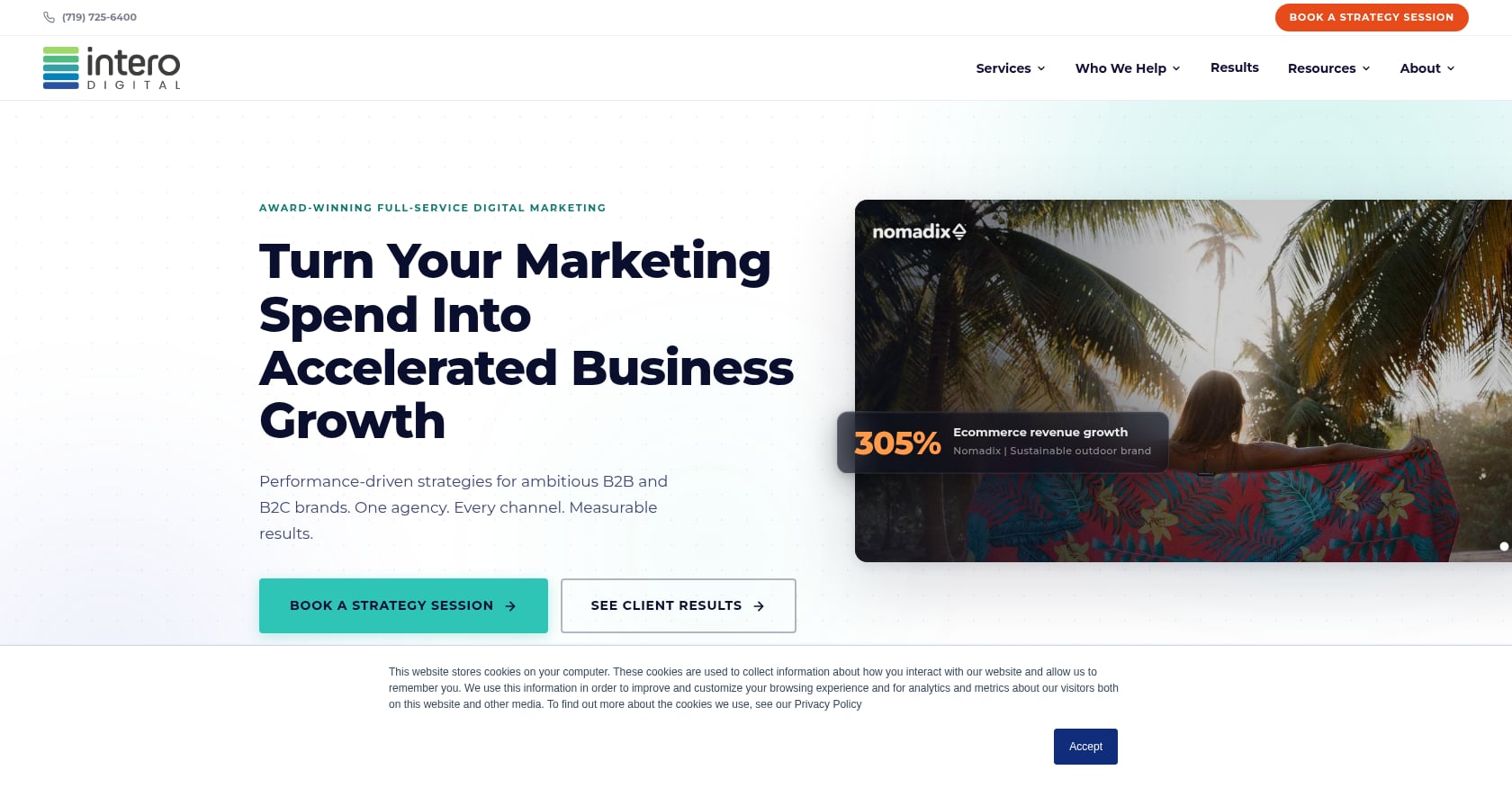
Best for: Larger brands needing full-service digital with SEO, paid media, content, digital PR, Amazon, and AI-search/GEO capabilities.
Pricing: Clutch lists a $1,000+ minimum project size with the most common project size between $10,000-$49,999, based on 118 reviews source.
Key features:
- SEO, paid media, and content
- Digital PR
- Amazon services
- AI-search and generative-response optimization positioning
User sentiment: Clutch rates them 4.8 across 147 reviews. A manufacturing client praised niche understanding and reported increased quote requests. A negative review from an advertising company described severe dissatisfaction with a Meta advertising engagement, claiming no functional work was delivered before termination source.
Tradeoffs:
- Large agency model means quality may vary depending on the team assigned to your account
- The review profile includes serious negative feedback alongside strong positives
- Less hands-on than boutique DTC marketing partners for lean teams needing daily governance
Who should choose it: Enterprise or larger mid-market brands that need broad digital capabilities under one roof and can vet team assignment closely during onboarding.
7. DTC Pages
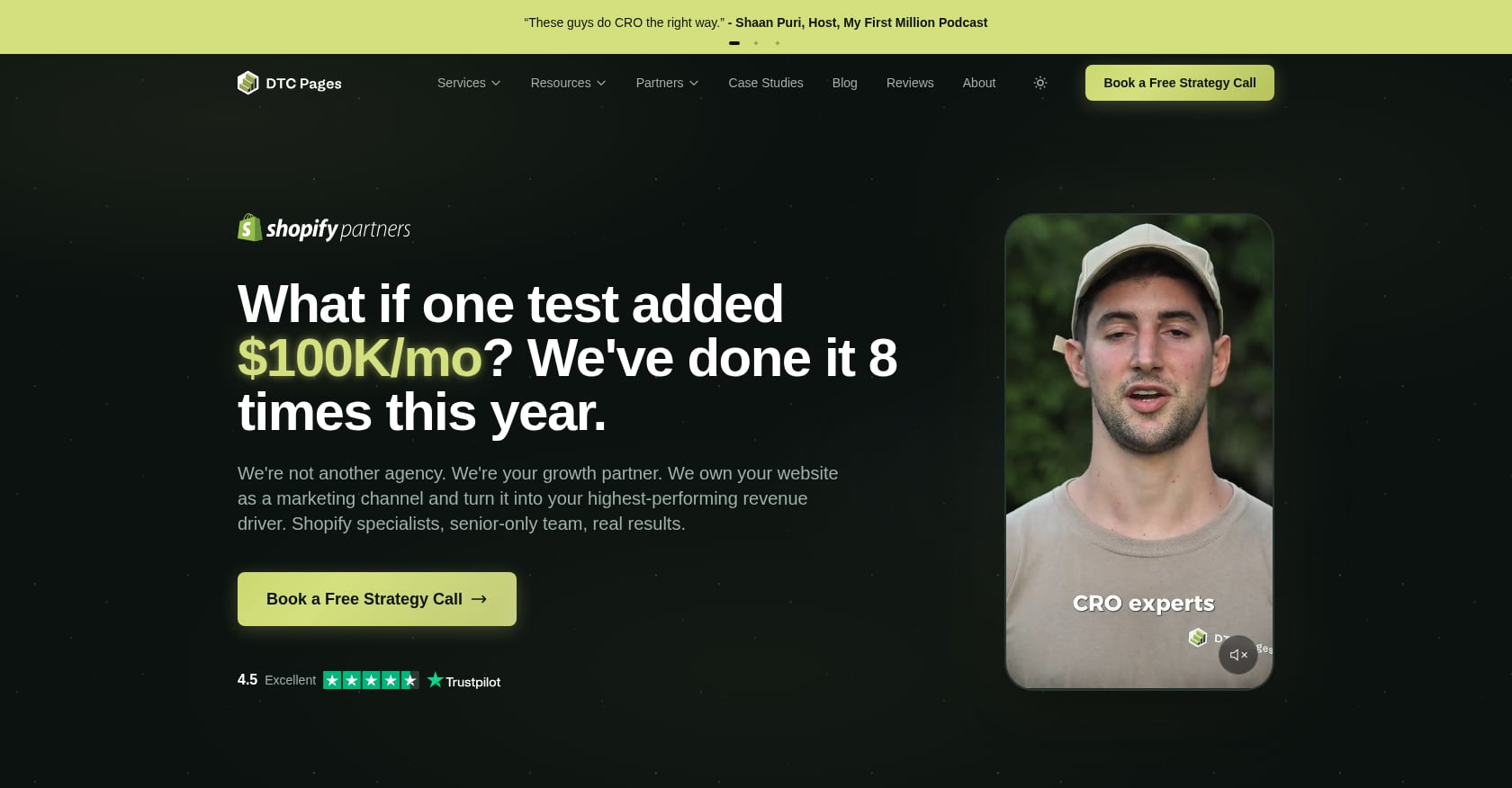
Best for: High-revenue Shopify brands focused on conversion-rate optimization, landing pages, A/B testing, and emerging AI-shopping visibility.
Pricing: Shopify’s Partner Directory lists selected services starting from $49 and CRO starting at $99, though the full program price should be verified directly. The profile states they work with 7-9 figure DTC brands source.
Key features:
- CRO audits and A/B testing
- Landing page design and optimization
- Product schema and structured data
- AI search and agentic checkout visibility
- AI-traffic attribution
User sentiment: Profile cites a 4.5 Trustpilot rating and offers a money-back guarantee, but review depth should be verified independently.
Tradeoffs:
- CRO/GEO specialization does not replace paid media, lifecycle marketing, Amazon management, or operational support
- Pricing needs confirmation beyond the directory listing
- Best used as a specialist CRO layer alongside a broader DTC marketing partner
Who should choose it: Brands whose traffic is already strong but conversion is weak, and who want a specialist focused purely on landing pages, PDPs, checkout flow, and structured data.
8. eCommerce Today
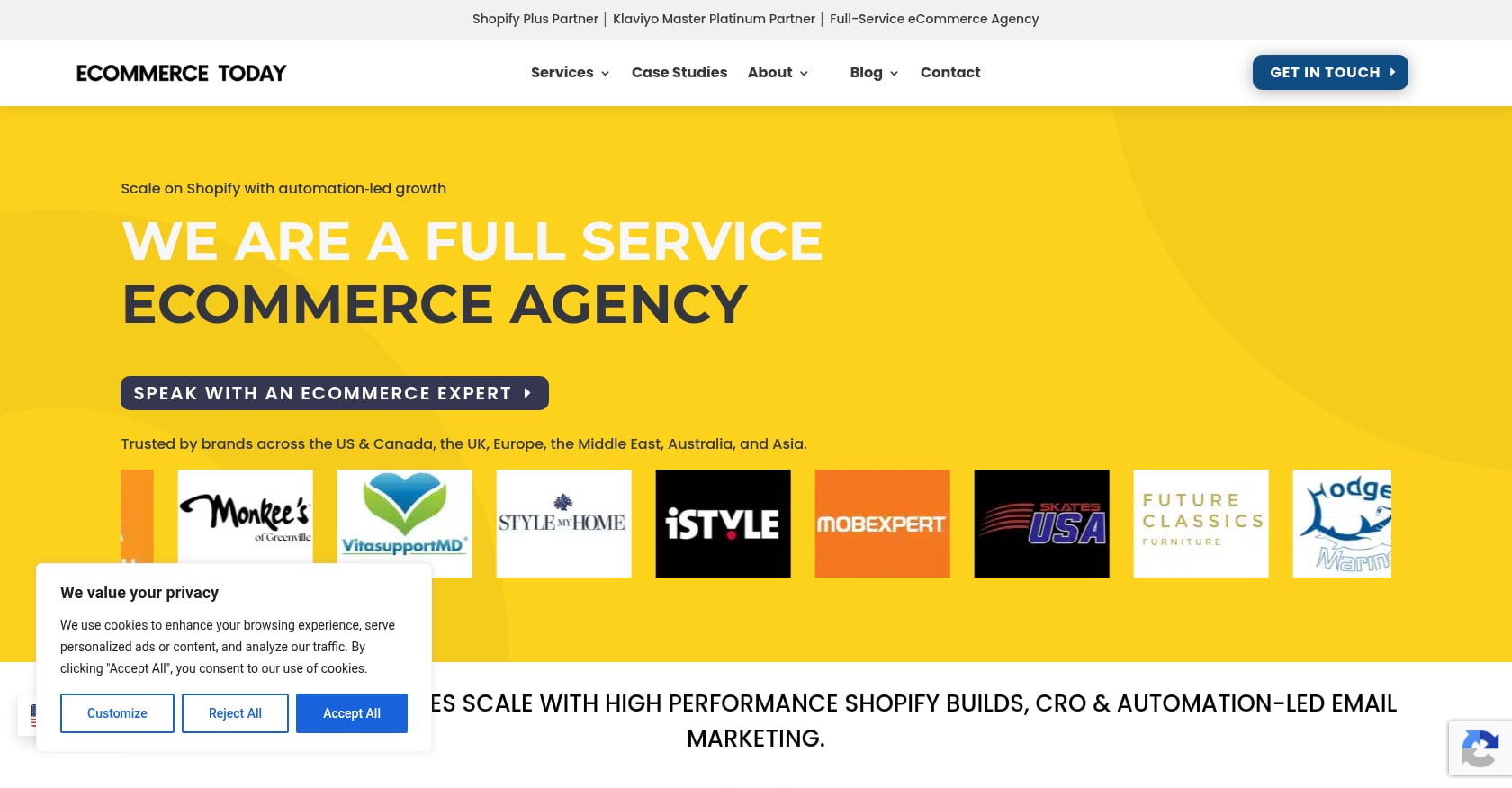
Best for: Shopify and Shopify Plus brands that need development, store optimization, PPC, and SEO at a relatively accessible price point.
Pricing: Clutch profile snippet shows project costs ranging from $1,125 to $12,000 per year depending on scope source.
Key features:
- Shopify Plus agency services
- PPC across Google, Meta, and TikTok
- SEO and AEO (answer engine optimization)
- Solutions for growth-stage and established brands
User sentiment: 53 Clutch reviews signal strong volume. Individual review themes should be verified for DTC-specific relevance before making deeper claims.
Tradeoffs:
- The low annual project-cost range likely reflects smaller scoped work, not full-service DTC marketing strategy
- Less suited for complex Amazon + D2C strategic governance or intense creative production
- May function more as Shopify execution support than a growth partner
Who should choose it: Budget-conscious Shopify brands that need development and basic PPC/SEO support without a full-service retainer commitment.
Why Amazon and DTC Should Not Be Planned in Silos
Most DTC marketing agency lists focus entirely on Shopify and paid social. That misses a critical reality for consumer brands: Amazon influences DTC performance whether you plan for it or not.
Amazon captures bottom-of-funnel demand generated by your DTC ads. Your DTC ads lift branded search that often converts on Amazon. Stockouts on Amazon hurt rank and momentum. Weak Amazon listings hurt brand trust even if your Shopify store looks great. Amazon Ads supports negative keyword and product targeting to prevent wasted impressions source, and Amazon Brand Stores can serve as landing pages for Sponsored Brands.
Amazon has also introduced Buy with Prime marketing solutions that can direct Amazon shoppers to DTC sites, blurring the line further between marketplace and direct channels.
Brands selling across both channels need their Amazon PPC architecture and DTC media to share keyword, review, offer, and inventory insights. An agency that manages one channel without understanding the other is leaving money on the table, or worse, actively creating conflicts.
The Agency Should Talk About Cohort Margin, Not Just ROAS
Platform-reported ROAS can hide poor economics. A campaign that looks profitable in Meta Ads Manager may be claiming credit for existing customers, branded search, or people who would have purchased anyway.
A DTC founder on Reddit described this clearly: in-platform numbers looked fine, but cohort contribution margin, payback periods, and flat repeat purchase rates showed the business was only buying one-time customers. Warning signs included LTV:CAC falling below 3 over a 90-180 day window and returning-customer revenue share failing to rise.
Another Shopify DTC founder reflected after two years of growth that Meta/Instagram ads worked early, Google Shopping later became the largest and most profitable paid channel, and it did not make sense to spend $100+/month on email software when the store was only doing around $1,000/month in revenue. The lesson: founders often over-index on attribution apps and under-index on retention math.
Any DTC marketing agency worth hiring should be able to discuss contribution margin, blended CAC, new-customer CAC, payback period, and repeat purchase rate, not just in-platform ROAS.
Red Flags When Hiring a DTC Agency
Watch for these warning signs:
- Talks only about ROAS, never margin. Platform ROAS is not profit. Ask how they measure contribution margin.
- Cannot explain attribution windows. If they do not know how their CAPI implementation works or what their attribution model actually measures, attribution is guesswork. For deeper context, read about CAPI setup for Meta.
- Does not ask about inventory. Running ads into a stockout burns money and rank simultaneously.
- No creative testing cadence. Ask how many net-new concepts they test per month and how they decide what earns more spend.
- Treats email/SMS as “set and forget.” Lifecycle marketing should evolve with customer data, not run the same three flows forever.
- Cannot distinguish branded search defense from incremental acquisition. If branded and non-branded campaigns are lumped together, the numbers are inflated.
- Claims every brand should run the same channel mix. A Shopify brand doing $5K/month needs a different sequence than one doing $500K.
- No plan for GA4, product feeds, or Amazon reporting. Measurement infrastructure is not optional.
Several Reddit threads on agency directories also warn that Clutch and DesignRush visibility can be affected by sponsorship and profile optimization. Directory ratings are a useful starting point, but buyers should ask for relevant case studies, talk to references, and inspect actual work samples.
When You Are Not Ready for a DTC Marketing Agency
Hiring an agency will not fix foundational problems. Consider holding off if:
- You do not know your gross margin or contribution margin by SKU
- You cannot fulfill orders consistently
- You have no product-market fit yet
- Your product detail pages cannot explain the product clearly
- Your AOV cannot support paid acquisition economics
- You expect platform-reported ROAS to equal profit
- You have no budget for creative production or testing
- You want a channel vendor to fix a weak offer
An honest agency will tell you this upfront. That honesty is itself a quality signal.
12 Questions to Ask Before Hiring
Use this checklist during agency evaluations:
- What percentage of your recommendations are based on contribution margin versus platform ROAS?
- How do you separate branded, retargeting, and true new-customer acquisition?
- How many creative concepts do you test per month?
- Who owns product-feed quality?
- How do you handle GA4, GTM, and CAPI setup?
- What is your plan if inventory runs out during a campaign?
- How do Amazon search terms influence Google/Meta creative and landing pages?
- Do you optimize for ACOS, TACOS, or contribution margin?
- How do you measure retention after first purchase?
- What work is included in the retainer versus billed separately?
- What reporting will we see weekly?
- Can we speak to a client in our category or revenue stage?
Which DTC Marketing Partner Fits You?
If your main problem is creative fatigue, a creative-performance agency like Y’all makes sense. If you need CRO specialist work, DTC Pages can focus there. If you are a Shopify Plus CPG brand where subscription mechanics drive everything, Tribe is worth evaluating.
But if your growth is split across Amazon, Shopify or WooCommerce, Google, and Meta, and no one owns the full margin picture, a unified approach matters more than any single-channel specialist. That is the gap EZCommerce fills: profit-first planning, Amazon and D2C execution, CRO, analytics, compliance, and inventory support under one team with 90-day governance cadence.
Start with a free brand audit to identify where growth is leaking before committing to any agency.
Frequently Asked Questions
What is DTC marketing?
DTC marketing promotes products directly to consumers instead of through retail intermediaries. This gives brands more control over branding, customer data, distribution, and margins. In practice, most DTC brands today sell across multiple channels (Shopify, Amazon, wholesale) while using direct-to-consumer strategies as the core growth engine.
What does a DTC marketing agency do?
A DTC marketing agency typically handles paid acquisition (Google, Meta, TikTok), performance creative, lifecycle email and SMS, SEO, conversion rate optimization, and analytics. More comprehensive partners also manage Amazon PPC, marketplace compliance, inventory planning, and cross-channel reporting.
How much does a DTC marketing agency cost?
Costs vary widely. Industry data from MarketerHire shows DTC agency retainers commonly run $6,000-$25,000+ per month, with many mid-stage brands paying $10,000-$18,000. Some agencies add 5-15% of managed ad spend. EZCommerce offers tiered pricing starting at $499/month for Amazon EzAds and $999/month for D2C EzAds. Total costs also include media spend, creative production, platform fees, and tools.
Is Amazon part of DTC marketing?
Strictly speaking, Amazon is a marketplace, not a DTC channel. Practically, Amazon affects DTC demand, reviews, pricing perception, branded search volume, and conversion trust. Brands selling on both Amazon and their own store should coordinate ad strategy, inventory, and reporting across both channels rather than treating them as separate businesses.
What metrics matter most for DTC marketing?
Conversion rate, customer acquisition cost, and customer lifetime value top the list according to a Digiday/Klaviyo industry survey. Beyond those, the metrics that separate profitable brands from unprofitable ones include contribution margin by SKU, blended CAC, TACOS (for Amazon), repeat purchase rate, payback period, and checkout conversion rate.
How long should it take to see results from a DTC agency?
Tracking fixes and campaign cleanup typically take 2-4 weeks. Paid creative and CRO tests need 30-90 days depending on traffic volume. Retention, SEO, and content strategies require 3-6+ months. Amazon organic rank improvements often take 6+ months as ads, listing quality, reviews, and inventory compound together.
Should I hire an agency, freelancer, or build in-house?
It depends on scale and complexity. Early-stage brands doing under $10K/month in revenue often benefit from one skilled freelancer or founder-led execution. Brands in the $50K-$500K/month range frequently benefit from an agency that can coordinate multiple channels and provide governance. Larger brands may build hybrid teams with in-house strategists and agency execution partners.
How do I know if my current agency is underperforming?
Look beyond platform ROAS. Check whether LTV:CAC is above 3 over a 90-180 day window, whether returning-customer revenue share is rising, whether contribution margin is improving alongside revenue, and whether the agency can explain exactly how tracking and attribution work. If the answer to any of those is unclear, it is time to dig deeper.