


7 Best Facebook Ad Companies for Ecommerce Brands (2026)
TL;DR
Meta remains the top prospecting channel for ecommerce, but managing it well requires Advantage+ fluency, server-side tracking, and relentless creative testing. This guide covers seven Facebook ad companies suited to different budgets and business stages, with real pricing data, honest tradeoffs, and a vetting framework so you can evaluate any agency before signing a contract. If you sell products online and need Facebook ads managed alongside your broader growth channels, start here.
Why Ecommerce Brands Hire Facebook Ad Companies
Over 10 million businesses actively advertise on Facebook. The platform’s average cost per click sits around $0.80 in 2026, making it one of the cheapest prospecting channels available. But cheap clicks don’t automatically translate into profitable sales. Meta ads fatigue within weeks and need constant creative refreshes. The Ads Manager interface is notoriously confusing. One Trustpilot reviewer described being in business for eight years and still not being able to figure out how to run an ad on Meta.
That complexity is the whole reason Facebook ad companies exist. A good agency handles creative production, audience strategy, tracking setup, and daily optimization so brand owners can focus on product and operations.
The problem? Most “best agencies” lists recycle the same names with no real pricing and no ecommerce-specific evaluation criteria. This article fixes that. Every agency below is evaluated through an ecommerce lens, with actual dollar amounts, Clutch ratings, and honest limitations.
Looking for a quick assessment of where your brand stands? EZCommerce offers a free ecommerce brand audit that includes a scorecard, quick wins, and a 90-day action plan delivered within 5 to 7 business days.
At-a-Glance Comparison Table
| Company | Best For | Starting Price | Pricing Model | Clutch Rating | HQ |
|---|---|---|---|---|---|
| EZCommerce | Unified Amazon + D2C + Meta growth | $999/mo | Flat retainer | N/A | Irvine, CA |
| Disruptive Advertising | Mid-market brands ($10K+/mo spend) | ~$4,000/mo | % of spend / retainer | 4.8 (371 reviews) | Utah |
| KlientBoost | Paid social + CRO + landing pages | ~$2,000/mo | Retainer / % of spend | 4.9 (404 reviews) | Costa Mesa, CA |
| SmartSites | SMBs wanting full-funnel Meta + retargeting | ~$750/mo | Retainer / % of spend | 4.9 (368 reviews) | Paramus, NJ |
| LYFE Marketing | Small businesses with tight budgets | ~$650/mo | Retainer (scales with spend) | 4.4 (156 reviews) | Atlanta, GA |
| Sociallyin | Creative-first consumer brands | ~$5,000 project min | Custom retainer | 4.8 (62 reviews) | Atlanta, GA |
| ROI Minds | Budget ecommerce (offshore) | ~$1,000 project min | Custom / low hourly | 4.9 (100 reviews) | India |
How We Evaluated These Facebook Ad Companies
Not every agency is built for product brands. We filtered for the following criteria:
- Ecommerce specialization: Do they run catalog ads, dynamic product ads (DPA), and Advantage+ Sales campaigns regularly?
- Pricing transparency: Can you find real numbers before a sales call?
- Tracking expertise: Do they set up Conversions API (CAPI) and GA4, or rely solely on the browser pixel?
- Third-party reviews: What do clients say on Clutch, G2, and in communities like the Shopify forums?
- Multichannel capability: Facebook ads don’t exist in a vacuum. Can the agency connect paid social to your broader growth strategy?
One respondent on the Shopify community forum put it well: choose agencies focused on long-term growth rather than just clicks, and look for real case studies, ROI tracking beyond impressions, and integration of ads with SEO and conversion rate optimization. That advice shaped how we built this list.
The 7 Best Facebook Ad Companies for Ecommerce
1. EZCommerce
Best for: Ecommerce brands that want Facebook/Meta ads managed inside a unified Amazon + D2C growth system, not as a standalone channel.
EZCommerce is a California-based ecommerce growth agency that treats Meta advertising as one component of a profit-first plan. Instead of optimizing Facebook in isolation, the agency ties ad performance to contribution margin and connects paid social to Amazon visibility, CRO, inventory planning, and analytics.
Key services:
- Meta Advantage+ and DPA management for Shopify stores
- Clean GTM/GA4/CAPI tracking setup
- Weekly or biweekly governance cadence with reporting
- CRO Suite for PDP and checkout A/B testing
- Analytics and MMM dashboards (LTV, CAC, ROAS, margin)
- Inventory depth planning and 3PL coordination
Pricing:
- D2C EzAds: starts at $999/month
- D2C EzScale (full service): starts at $1,999/month
What sets it apart: The “Rank and Ads Loop” methodology links Amazon paid visibility to organic rank gains, reducing CPC and cost of goods over time. EzGuard compliance and IP protection comes embedded in the retainer. This isn’t a Facebook-only shop. It’s a D2C growth services operation that happens to be very good at Meta ads.
Tradeoffs:
- Boutique scale with fewer marquee case studies compared to large agencies
- Focused on Amazon + core D2C stack (Shopify/WooCommerce, Google, Meta) rather than global retail media at enterprise scale
- Not the right fit for brands that only need a Facebook ads freelancer
Free entry point: A free ecommerce brand audit that includes a 30 to 45 minute call, a scorecard, and a 90-day action plan.
2. Disruptive Advertising
Best for: Mid-market and enterprise brands spending $10K+ per month on ads who need strategic depth and structured creative testing.
Disruptive Advertising is one of the most recognized names among Facebook ad companies, particularly for brands with meaningful budgets. Their team runs Meta alongside Google, LinkedIn, and other paid channels, with a focus on full-funnel reporting.
Key services:
- Facebook and Instagram ad management
- Creative strategy and testing
- Landing page design
- Full-funnel analytics
- Multi-channel paid media management
Pricing:
- Entry-level retainer: $4,000 to $6,000/month for accounts spending $10,000 to $25,000/month on ads
- Setup/onboarding fee: $1,000 to $3,000 depending on account complexity
- Pricing scales with ad spend and channel count
What clients say: On Clutch (4.8 stars from 365+ reviews), clients describe Disruptive as exceptionally responsive. The sharpest complaints describe exorbitant termination fees and charges for services not rendered during offboarding.
Tradeoffs:
- Contract terms of 3 to 6 months minimum
- Not suitable for brands with sub-$10K/month ad budgets
- Termination fees can be significant, so read the contract carefully
- Generalist approach may lack the ecommerce-specific depth of a specialized agency
3. KlientBoost
Best for: Mid-market brands ($10K to $100K/month ad spend) that want paid social tied to landing page and CRO work under one roof.
KlientBoost is a strong pick for brands that recognize the post-click experience matters as much as the ad itself. They pair Facebook ad management with landing page builds and conversion rate optimization. For a deeper look at why CRO matters alongside paid media, see this guide on optimizing website conversion rates.
Key services:
- Facebook and Instagram ad management
- Landing page design and A/B testing
- Google Ads management
- CRO audits and implementation
- Email marketing
Pricing:
- Monthly retainers: $2,000 to $15,000+ depending on scope
- Percentage of ad spend model: 12% to 30% (15% to 20% is common)
- Performance hybrid available (base fee plus bonuses)
What clients say: Clutch profile shows 4.9 stars across 404 reviews with a minimum project size of $1,000+.
Tradeoffs:
- Multi-channel breadth means less depth than a Meta-only specialist for advanced accounts
- Below $5,000/month in ad spend, agency fees consume too much of the budget
- Not ecommerce-specific, so you’ll want to confirm their catalog ads and DPA experience
4. SmartSites
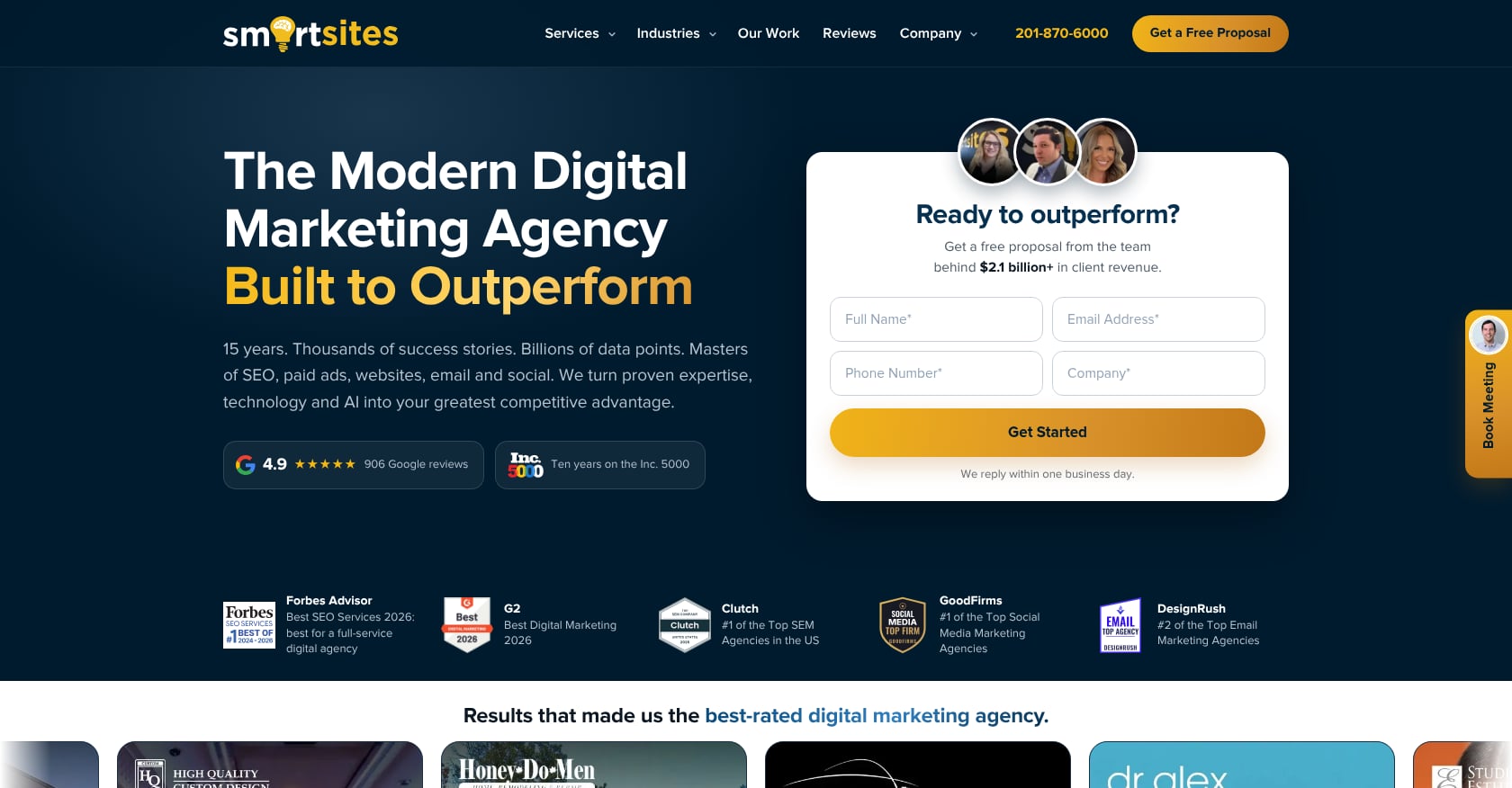
Best for: SMBs wanting full-funnel Meta ads with month-to-month flexibility and strong retargeting.
SmartSites is a Meta Business Partner that serves a wide range of verticals. Their month-to-month contracts make them appealing for smaller brands testing the waters with a Facebook ad company for the first time.
Key services:
- Facebook and Instagram ad creation and management
- Retargeting campaign setup
- PPC management (Google, Bing)
- Web design and SEO
- Social media marketing
Pricing:
- PPC packages start at $750/month
- Social media marketing packages at $1,250/month
- Overall range: $1,000 to $10,000/month depending on scope
What clients say: 4.9-star rating across hundreds of Clutch reviews. However, some reviewers note that SmartSites doesn’t provide a campaign tracking dashboard, so you rely on their reports to monitor campaign data.
Tradeoffs:
- Generalist agency serving many verticals, not ecommerce-focused
- Some reviewers note metrics emphasize vanity KPIs (clicks, leads) over revenue
- No self-serve dashboard for real-time campaign monitoring
- Ask specifically about Advantage+ and CAPI experience before signing
5. LYFE Marketing
Best for: Small businesses and startups with limited budgets, especially those new to paid social.
LYFE Marketing is one of the more accessible Facebook ad companies for brands just getting started. Their price floor is the lowest on this list, which makes them a realistic option for businesses spending under $3,000 per month on ads.
Key services:
- Facebook and Instagram ad management
- Social media management (organic)
- Email and SMS marketing
- Short video ad creation
- PPC management
Pricing:
- Monthly management: approximately $650 to $2,500
- Recommended minimum ad spend: $500/month
- Typical contract length: 3 months
- Setup fees apply on top of management fees
What clients say: On Clutch (4.4 stars from 156 reviews), fans cite quick responses and strong customer service. Unhappy clients describe campaigns that underperformed organic results and creative assets that were extremely low quality.
Tradeoffs:
- Management fees scale up with ad spend, and setup fees add to the total
- Creative quality inconsistent based on reviews
- Not built for ecommerce brands needing catalog ads, DPA, or Advantage+ campaigns
- 4.4 Clutch rating is the lowest on this list
6. Sociallyin
Best for: Consumer brands that need strong creative (video, photography) alongside paid social management.
Sociallyin approaches Facebook advertising from a creative-first angle. They operate an in-house production studio, which means the creative and media buying teams sit close together. For brands where visual storytelling drives purchases, that matters.
Key services:
- Paid social management (Facebook, Instagram, TikTok)
- In-house creative production (video, photography)
- Social media strategy and organic management
- Influencer marketing
- Community management
Pricing:
- Projects start around a $5,000 minimum
- Custom retainer pricing based on scope
What clients say: On Clutch (4.8 stars from 62 reviews), clients praise the blend of creative storytelling with data-driven optimization. The most common criticism is that creative alignment required additional revision rounds.
Tradeoffs:
- $5,000 minimum sits above what many small businesses allocate to paid social
- Community-first approach may not be aggressive enough for pure ROAS-focused brands
- Fewer reviews than competitors, limiting the sample size for evaluation
- Their strength is holistic social, not granular ecommerce performance
7. ROI Minds
Best for: Budget-conscious ecommerce brands willing to work with an offshore team for significantly lower costs.
ROI Minds is an India-based agency that keeps pricing well below US competitors. For ecommerce brands that need competent Facebook ad management but can’t justify $3,000+/month in agency fees, they’re worth evaluating.
Key services:
- Facebook and Instagram ad management
- Google Ads management
- Shopify marketing
- Conversion tracking setup
- Creative design
Pricing:
- Minimum project size: $1,000+
- Hourly rate: under $25/hour
- Cost rating on Clutch: 4.9/5
What clients say: 4.9 stars on Clutch across 100 reviews. However, ROI Minds has fewer publicly available Facebook Ads case studies than more established agencies. One GoodFirms review alleged billing issues.
Tradeoffs:
- Offshore team means time-zone differences can slow communication
- Limited brand-name case studies and a smaller portfolio
- May lack the strategic depth of premium agencies for complex accounts
- Billing disputes flagged in at least one public review
How Much Do Facebook Ad Companies Cost? (2026 Pricing Breakdown)
A Meta ads agency typically costs $2,500 to $12,000 a month on a flat retainer, or 10% to 20% of ad spend. Understanding what you’re paying for matters as much as understanding how much you’re paying. For a deeper look at measuring returns, check out this guide on ROAS formulas and benchmarks.
Four common pricing models
Percentage of ad spend is the most common model. Agencies charge between 10% and 20% of your monthly Meta budget. If you’re spending $10,000/month on ads, expect $1,000 to $2,000 in management fees on top.
Flat monthly retainers range from $1,500 to $15,000 monthly depending on scope. Smaller boutique agencies charge $1,500 to $3,000 for basic campaign management.
Performance-based or hybrid models include a base fee ($500 to $2,000) plus a bonus or percentage based on ROAS or sales targets.
Setup fees range from $500 to $7,000. The 2026 industry median hourly rate for agency work is approximately $137.50/hour.
What you get at each price tier
| Monthly Spend | What to Expect |
|---|---|
| $650 to $1,000 | Basic campaign management, limited creative, templated reporting |
| $1,000 to $3,000 | Dedicated strategist, custom audiences, some creative production, regular reporting |
| $3,000 to $6,000 | Multi-campaign architecture, creative testing, CAPI setup, CRO recommendations |
| $6,000 to $12,000+ | Full creative studio, Advantage+ optimization, MMM or attribution modeling, weekly calls |
Hidden costs to watch for
Setup or onboarding fees that aren’t disclosed upfront. Creative production charged separately (some agencies quote management fees only, then bill $500+ per ad creative). Early termination fees, which can be steep at agencies like Disruptive Advertising based on client reviews. And minimum contract lengths of 6 to 12 months that lock you in before you can evaluate performance.
How to Vet a Facebook Ad Company Before You Sign
Choosing from a list is the easy part. The hard part is figuring out whether an agency is actually competent before you hand over money. Here’s a framework built from practitioner insights and common mistakes.
Let the agency lead the discovery call
A media buyer writing on Substack (modernmediabuying.substack.com) offered this advice: what agencies ask, or don’t ask, tells you more about their capabilities than their websites and pitch decks ever will. Let them lead the conversation and see if they ask about your funnels, conversion rates, average order value, lifetime value, customer acquisition cost, and retention metrics. If they only ask about your ad budget and target ROAS, that’s a shallow operation.
Are they taking a holistic approach to improving your performance? Or do they just want to know your monthly spend so they can calculate their fee? This is a high-signal differentiator.
For a structured approach to evaluating agencies, the ecommerce profit scorecard walks through the financial questions that matter most.
Six red flags
-
Cherry-picked data. A practitioner on nailitandscaleit.substack.com warns: “Almost always, when called out on their pie-in-the-sky promises, shady agencies will show cherry-picked data that does not hold up. Maybe they will show 1 week of performance, or ads targeted at warm traffic, or a client spending an absurdly small budget that got lucky for a short period.”
-
Contracts longer than 6 months. The same source flags this directly: “Making it hard for you to leave is a red flag. Some marketers do this by having you sign very long contracts, 12 months or more.”
-
No mention of CAPI or server-side tracking. Browser-based pixel tracking now captures approximately 40% of actual conversions due to iOS restrictions and ad blockers. Any agency still relying solely on the pixel is optimizing against incomplete data.
-
Vanity metric reporting. If the agency talks about impressions and reach but not cost per acquisition, contribution margin, or blended ROAS, they’re not managing for profit.
-
No account ownership. You should always own your ad account, pixel, and data. If the agency runs campaigns under their account, you lose everything when you leave.
-
No ecommerce client percentage disclosed. An agency where most clients spend $10,000/month on lead generation has built its processes around a completely different model. A $1,500/month ecommerce account in that shop gets a scaled-down version of a process designed for something else entirely.
Five must-ask questions
- Do you run Advantage+ Sales campaigns, and what’s your typical ROAS on them?
- Do you set up server-side CAPI tracking, or do you rely on the browser pixel alone?
- How many new ad creatives do you produce per month, and what’s your testing cadence?
- What percentage of your current clients are ecommerce brands?
- What does your reporting include, and how frequently do we meet?
Why Ecommerce Brands Need Advantage+ and CAPI Expertise in 2026
This section matters because it’s the single biggest technical differentiator between competent Facebook ad companies and outdated ones.
Advantage+ Sales campaigns are now the default
Meta renamed Advantage+ Shopping Campaigns to Advantage+ Sales Campaigns in 2025, and through 2026 you can no longer create the legacy Shopping format. The ASC acronym is still widely used, but the current Ads Manager label is Advantage+ Sales.
For stores with sufficient purchase data (50+ weekly conversions), these campaigns frequently outperform manual campaigns. The numbers are striking: Advantage+ Shopping Campaigns average 4.52x ROAS compared to the 2.79x ecommerce average across all campaign types. Meta reports that brands using Advantage+ correctly see a 22% higher ROAS and 12% lower cost per action versus manual equivalents.
If the agency you’re evaluating can’t explain their Advantage+ strategy in concrete terms, keep looking.
CAPI is non-optional
Browser-based pixel tracking misses roughly 60% of conversions because of iOS privacy changes and ad blockers. Running Advantage+ on pixel-only data means the algorithm optimizes against incomplete signals. That’s like trying to drive with a dirty windshield.
Conversions API (CAPI) sends purchase and conversion data directly from your server to Meta, bypassing browser limitations. For Shopify stores specifically, there’s a detailed walkthrough of setting up Facebook CAPI that covers the full implementation process.
Any Facebook ad company you hire in 2026 should set up server-side CAPI tracking as a standard part of onboarding. If they treat it as an upsell or don’t mention it at all, that’s a disqualifying signal.
For brands also exploring how Facebook lookalike audiences have evolved alongside these tracking changes, the relationship between audience quality and signal accuracy has never been more direct.
When You Need More Than Just a Facebook Ad Company
Here’s the uncomfortable truth: hiring an agency to run Facebook ads in isolation often underperforms. Meta is a prospecting channel. It drives awareness and first clicks. But if your product pages don’t convert, your checkout leaks, your inventory runs out during a winning campaign, or your Amazon and D2C strategies cannibalize each other, no amount of Facebook optimization fixes the problem.
Practitioners on Reddit and ecommerce forums consistently report that siloed channel management leads to misaligned budgets. You end up with a Facebook agency optimizing for ROAS, a Google agency optimizing for a different ROAS number, and no one looking at blended profitability or contribution margin.
This is where the distinction between a Facebook ad company and a growth partner matters. The best outcomes happen when Meta ads connect to the bigger picture: Amazon paid visibility feeding organic rank, D2C conversion rate optimization lifting the value of every click, and inventory planning ensuring you don’t run dry when a campaign takes off. For brands selling on both Amazon and their own store, understanding how D2C ad strategies differ from marketplace-first approaches is essential context.
EZCommerce was built around this exact problem. Their model integrates Meta advertising with Amazon management, CRO, analytics, and inventory coordination under one governed plan. If you’re spending across multiple channels and want someone connecting the dots, get in touch with EZCommerce to explore whether a unified approach fits your brand.
FAQ
How much do Facebook ad companies charge?
Most charge $2,500 to $12,000 per month on a flat retainer, or 10% to 20% of your monthly ad spend. Setup fees range from $500 to $7,000. Smaller agencies like LYFE Marketing start around $650/month, while mid-market agencies like Disruptive Advertising start at $4,000/month. Always ask about termination fees and creative production costs, as these are often hidden.
What’s the difference between a Facebook ad company and a social media agency?
A Facebook ad company focuses specifically on paid advertising, including campaign architecture, audience targeting, creative testing, bid management, and conversion tracking. A social media agency may handle organic posting, community management, and influencer partnerships in addition to (or instead of) paid ads. For ecommerce brands, paid performance expertise matters more than social content management.
Should I hire an agency or run Facebook ads myself?
If you’re spending under $2,000/month on ads and have time to learn the platform, self-management is viable. Above that threshold, the complexity of creative testing, Advantage+ optimization, CAPI tracking, and daily bid management usually justifies professional help. One Trustpilot reviewer described Meta’s self-serve platform as so complicated they couldn’t run an ad after eight years in business. The platform’s difficulty is a real barrier.
What is Advantage+ Sales (formerly Advantage+ Shopping)?
Advantage+ Sales is Meta’s AI-driven campaign type that automatically optimizes targeting, creative rotation, bidding, and delivery. It’s now the default for ecommerce advertisers and consistently outperforms manual campaigns for stores with 50+ weekly purchase events. Brands using Advantage+ correctly see roughly 22% higher ROAS and 12% lower cost per action compared to manual setups.
How long before I see results from a Facebook ad agency?
Expect 30 to 60 days for initial data collection and campaign optimization, with meaningful performance patterns emerging around month 2 to 3. Agencies that promise dramatic results in the first week are likely showing you warm-audience performance or cherry-picked data. Sustainable improvement in cost per acquisition and ROAS typically takes a full quarter.
Why does CAPI matter for Facebook ads in 2026?
Because browser-based pixel tracking now captures only about 40% of actual conversions due to iOS privacy restrictions and ad blockers. Without server-side Conversions API data, Meta’s algorithm optimizes against incomplete information, leading to worse targeting and higher costs. Any competent agency should implement CAPI as part of standard onboarding.
What should I ask a Facebook ad agency about their ecommerce experience?
Ask what percentage of their clients are ecommerce brands, whether they run Advantage+ Sales campaigns, how they handle catalog ads and DPA, and whether they set up CAPI tracking. Also ask for their average client ad spend. An agency optimized for $10,000/month lead generation accounts has fundamentally different processes than one built for $3,000/month product brands.
Can one agency handle both Amazon and Facebook ads?
Yes, and for many ecommerce brands this is the better approach. Running Amazon PPC and Meta ads through separate agencies often creates misaligned budgets and conflicting attribution. Agencies like EZCommerce integrate both channels under one growth plan, connecting paid visibility on Amazon to D2C prospecting on Meta and measuring profitability across the whole business.