


9 Best Conversion Rate Optimisation Agencies (2026)
TL;DR
Most ecommerce stores convert between 1.4% and 3.0% of visitors, meaning over 97% of paid traffic leaves without buying. Conversion rate optimisation agencies fix that. This guide evaluates nine CRO agencies across pricing, methodology, platform coverage, and honest tradeoffs so you can find the right fit. If you sell on both Amazon and D2C channels, EZCommerce offers CRO embedded in a unified growth system starting at $1,999/month. Pure-play CRO specialists like Invesp and Spiralyze start at $7,500 and $25,000/month respectively, and are better suited for enterprise brands with high traffic volumes.
Most ecommerce brands pour money into traffic. Google Ads, Meta campaigns, influencer deals. Then they watch 97% of those visitors leave without buying a thing.
The average ecommerce conversion rate sits at 2.5–3.0% across industries in 2026. Shopify stores specifically average just 1.4%, according to Littledata’s data. Meanwhile, customer acquisition costs keep climbing across every paid channel. At some point, buying more traffic stops making sense. Converting the traffic you already have becomes the higher-return move.
That’s where conversion rate optimisation agencies come in. The average CRO program delivers a 223% return on investment, making it one of the most profitable marketing investments available. For a site generating $5 million monthly, even a 2% conversion lift means an extra $100,000 in revenue. A $30,000 monthly retainer suddenly looks cheap.
But here’s the problem: most “best CRO agency” lists only cover Shopify. They ignore Amazon listing conversion, multi-channel D2C operations, and the tracking infrastructure that makes testing trustworthy in the first place. This guide covers all of it.
Below you’ll find nine conversion rate optimisation agencies evaluated across pricing, methodology, proof, and platform coverage, with honest tradeoffs for each.
Not sure where your conversion gaps are? EZCommerce offers a free ecommerce brand audit with 3–5 hours of expert analysis, a scorecard, and a 90-day action plan.
At-a-Glance Comparison Table
| Agency | Best For | Starting Price | Platform Focus | Pricing Model | Key Differentiator | Rating |
|---|---|---|---|---|---|---|
| EZCommerce | Unified Amazon + D2C CRO | $1,999/mo | Amazon, Shopify, WooCommerce | Retainer | CRO inside a full growth system with profit-first planning | N/A (boutique) |
| Invesp | Research-first enterprise CRO | $7,500/mo | Platform-agnostic | Retainer / Performance | SHIP framework, 900+ brands tested | 4.9/5 Clutch |
| Spiralyze | Predictive, guaranteed CRO | $25,000/mo | Platform-agnostic | Performance | Scrapes 78K+ sites to predict winning variants | N/A |
| Speero | Building experimentation programs | ~$200K/yr | Platform-agnostic | Retainer (annual) | ResearchXL framework by Peep Laja | 4.7/5 FeaturedCustomers |
| SplitBase | DTC/luxury brands at $10M+ | Custom | Shopify, DTC platforms | Retainer | 3Ps methodology, $100M+/yr in added revenue | N/A |
| Blend Commerce | Shopify-only brands (UK-based) | Custom (audit first) | Shopify / Shopify Plus | Project + retainer | In-house design + dev + CRO | Clutch reviews |
| KlientBoost | Bundled CRO + PPC management | $4,000–$6,000/mo | Platform-agnostic | Retainer + % of spend | Creative testing integrated with paid media | G2 reviewed |
| Conversion Fanatics | High-velocity A/B testing | Mid-tier | Shopify, WooCommerce | Retainer | 46% test success rate, 350+ companies | N/A |
| Conversion Rate Experts | Science-led enterprise CRO | Premium | Platform-agnostic | Project / retainer | Deep customer research methodology | N/A |
What a CRO Agency Actually Does (and Doesn’t)
Conversion rate optimisation is not a one-time website audit. It’s not a redesign project. And it’s not the same thing as running Google Ads.
A proper CRO agency runs a continuous cycle: research your visitors’ behavior, form hypotheses about what’s blocking conversions, design and code test variants, run A/B tests with statistical rigor, and implement winners. Then repeat. The best agencies layer in qualitative research (heatmaps, session recordings, customer surveys) alongside quantitative data to understand why visitors drop off, not just where.
Here’s a distinction most agency lists miss: Amazon product detail page optimization is CRO too. When an agency rewrites your bullet points, tests A+ Content layouts, or optimizes your main image to improve click-through and conversion rates on Amazon, that’s conversion rate optimisation. It just happens on a marketplace instead of your Shopify store. Our guide to Amazon A+ Content covers how those modules directly impact listing conversion.
What CRO agencies don’t do (or shouldn’t):
- They don’t drive traffic. CRO assumes you already have visitors to test against.
- They don’t replace your design team. They test specific elements, not build entire brand identities.
- They don’t guarantee overnight results. Statistically valid tests require time and traffic volume.
Understanding these boundaries helps you set realistic expectations before signing a contract.
How to Evaluate a CRO Agency: 5-Point Checklist
Practitioners on LinkedIn and in Convert’s experimentation ecosystem reports consistently note that buyers struggle to evaluate conversion rate optimisation agencies because there’s no industry standardization. One agency’s “data-driven approach” means rigorous Bayesian statistics; another’s means they looked at a heatmap once.
Use these five criteria to cut through the noise:
1. Methodology transparency. Ask for the name and steps of their testing framework. Agencies worth hiring have a documented process (like Invesp’s SHIP or Speero’s ResearchXL). If they can’t articulate their methodology beyond “we run A/B tests,” that’s a red flag.
2. Statistical rigor. How do they determine sample sizes? What’s their minimum test duration? Do they use frequentist or Bayesian statistics? These aren’t academic questions. Poor statistical practices lead to false positives that waste your dev resources. Our A/B testing roadmap for checkout funnels breaks down what proper test structure looks like.
3. Proof structure. Logos on a website mean nothing. Ask for specific metrics: “We increased checkout conversion by 18% for [named client] over 90 days.” Named clients with specific, verifiable outcomes beat vague claims every time.
4. Team composition. Who actually does the work? Some agencies sell you on senior strategists during the pitch, then hand your account to junior analysts. Ask who will be running your tests day to day and what their experience level is.
5. Pricing clarity. Understand exactly what’s included. Some retainers cover strategy only (you implement). Others include design, development, and tools. Hidden costs for extra tests, tool licenses, or implementation hours can inflate your monthly spend by 20–40%.
When NOT to Hire a CRO Agency
This is the advice most lists won’t give you: if your site gets fewer than 20,000 monthly sessions, don’t hire a CRO agency yet. A/B tests won’t reach statistical significance in reasonable timeframes at that traffic level. You’ll burn through budget running inconclusive experiments.
Instead, invest in traffic first. Build your D2C growth engine through paid media, SEO, and content, then bring in CRO once you have enough visitors to test against.
The Best Conversion Rate Optimisation Agencies
1. EZCommerce
Best for: Ecommerce brands selling on Amazon and D2C that want CRO as part of a unified growth system, not a standalone testing engagement.
Pricing:
- D2C EzAds (Google + Meta ads with clean tracking): starts at $999/month
- D2C EzScale (full service including CRO Suite): starts at $1,999/month
- Free Brand Audit available (no obligation)
What makes them different:
Most conversion rate optimisation agencies operate in a silo. They test your product pages, hand you a report, and move on. EZCommerce takes the opposite approach: CRO is embedded inside a broader system that covers Amazon advertising, Google and Meta ads, inventory planning, compliance, and analytics, all governed through 90-day plans with weekly reporting.
- CRO Suite includes A/B tests on product detail pages, checkout flows, offers, upsells/bundles, popups, and UX speed, targeting conversion rate lift within 30–45 days
- Profit-first planning ties CRO outcomes to contribution margin and TACOS, not just conversion rate in isolation (read more about why TACOS matters)
- Clean tracking foundation: GA4, GTM, and Meta CAPI setup happens before any testing begins, ensuring your test data is actually reliable
- Amazon + D2C under one roof: listing optimization, A+ Content, and PDP conversion work alongside Shopify/WooCommerce CRO
- Client brands include Tayfus, VRD Socks, and W Kitchen & Bath
Tradeoffs:
- Boutique scale with fewer public CRO-specific case studies compared to pure-play agencies like Invesp
- Strength is unified growth and operations, not standalone experimentation at massive scale
- Best suited for brands wanting one team managing traffic, conversion, inventory, and margin together
Entry point: The free brand audit delivers 3–5 hours of expert analysis, a scorecard with quick wins, and a 90-day action plan in about 5–7 business days.
2. Invesp
Best for: Mid-market to enterprise brands wanting deep, research-first CRO backed by massive institutional testing data.
Pricing: $7,500 to $300,000 depending on project scope and client size. Performance-based option available (pay only for the lift).
Key features:
- The oldest pure-play CRO agency in North America, founded in 2006
- SHIP framework (Scrutinize, Hypothesize, Implement, Propagate) provides a structured, repeatable testing methodology
- Claims revenue-positive A/B tests across 900+ brands, with up to 30% more conversions in 90 days
- 30 Clutch reviews at 4.9/5, five-time #1 CRO agency ranking on Clutch
User perspective: One G2 reviewer noted, “Invesp helped us audit our marketing messaging, and we immediately saw a lift in conversions on paid ads when it was implemented. They also weighed in on landing page design, the checkout funnel, CTA placement across our site.”
Tradeoffs:
- High price floor ($7,500/month minimum) puts them out of reach for many growing ecommerce brands
- Not ecommerce-specialist; they serve B2B, SaaS, and ecommerce equally, so your account team may not have deep Shopify or Amazon context
- Enterprise-scale brands with significant traffic volumes get the most value from their approach
3. Spiralyze
Best for: High-traffic ecommerce and SaaS sites wanting predictive, data-backed CRO with a performance guarantee.
Pricing: $25,000/month flat fee, month-to-month terms, no long-term commitment. Performance-based: you don’t pay fees until they deliver the promised lift.
Key features:
- Scrapes more than 78,000 websites for behavioral patterns, then uses that data to predict which test variants will win before you spend traffic running them
- Promises a 30% lift in conversions within 90 days, or you don’t pay
- Fees are all-inclusive, covering testing tools like VWO, CrazyEgg, Hotjar, and Mutiny
- Test-to-live cycle runs one to two weeks
Tradeoffs:
- Highest stated starting price among comparable agencies at $25,000/month
- The prediction engine works best when your site’s traffic profile resembles the sites in their training dataset; niche verticals may see less predictive accuracy
- The performance guarantee sounds great but should be scrutinized carefully, specifically how they define and measure “lift”
4. Speero
Best for: Mid-market to enterprise brands building a structured experimentation program (not just one-off tests).
Pricing: Not publicly listed. Typical annual engagements run around $200,000 (~$16,700/month).
Key features:
- Founded in 2011 by Peep Laja, widely regarded as the most influential CRO expert globally
- Built on the ResearchXL framework, a structured methodology that eliminates guesswork from conversion optimization
- Serves both lead-gen and ecommerce clients including ADP.com, MongoDB, Codecademy, and Native Deodorant
- Focus on building internal CRO capability alongside agency execution
Speero’s team has claimed that “90% of the analytics setups we’ve seen are critically flawed,” which underscores why clean GA4 and tracking implementation should be treated as a prerequisite before any serious testing program begins.
User perspective: One Trustpilot reviewer wrote, “Speero is far and away the best agency partner we have ever worked with. We have worked with them for multiple years and continue to find success together.”
Tradeoffs:
- Very high price point puts them firmly in enterprise territory
- Reviews appear on FeaturedCustomers (4.7/5, 30 references) rather than Clutch, where they have zero reviews, making independent verification harder
- Better for companies that want to build internal experimentation capability alongside the agency, not for brands wanting a fully outsourced solution
5. SplitBase
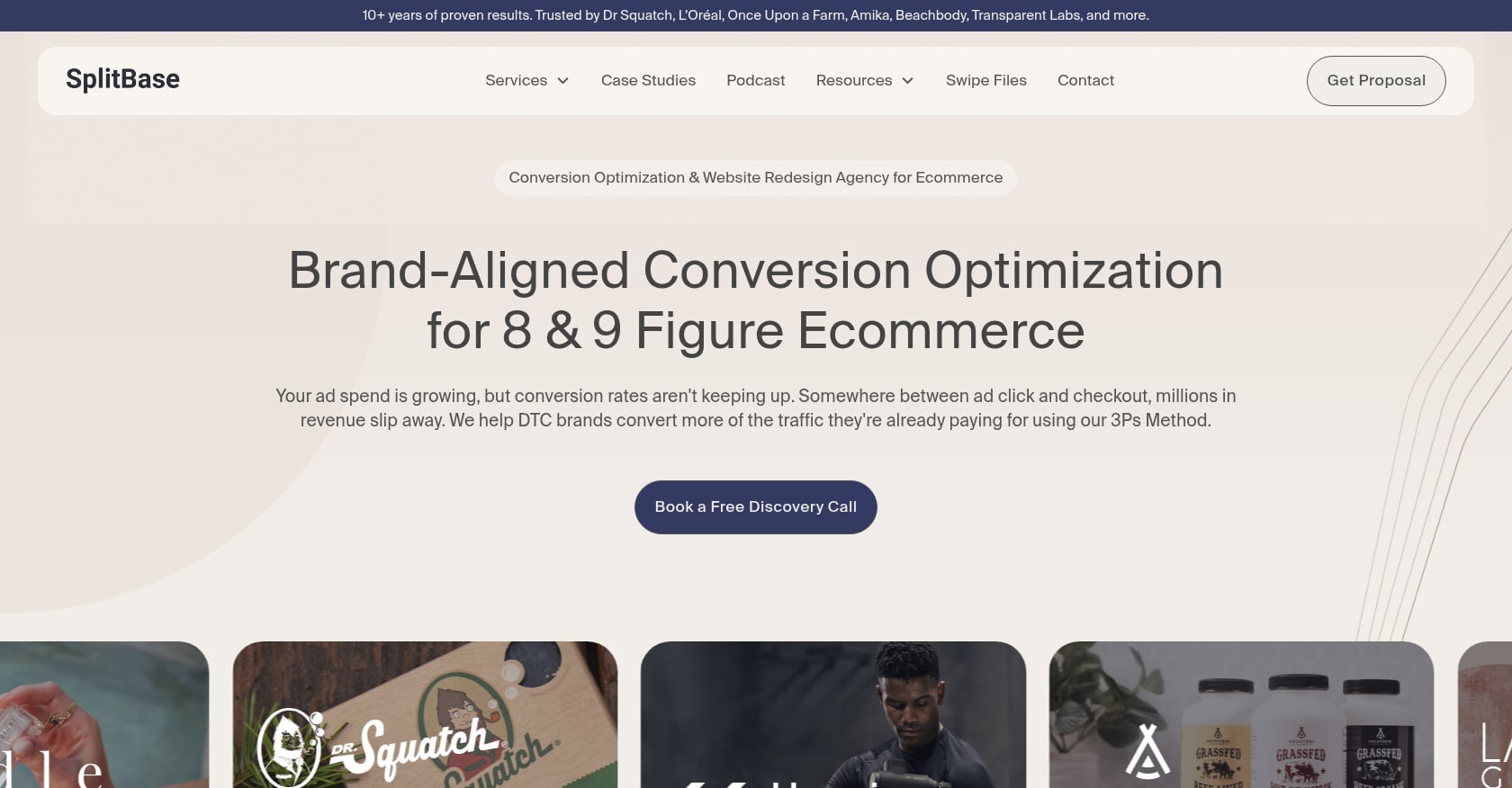
Best for: 8-9 figure DTC and ecommerce brands, especially in luxury, fashion, and beauty.
Pricing: Custom pricing across three tiers: full-site optimization (for $10M+ brands), conversion-focused redesigns, and landing page optimization.
Key features:
- Specializes exclusively in ecommerce conversion optimization with a focus on customer journeys, product pages, and checkout experiences
- Their 3Ps methodology has generated $100M+ per year in additional revenue for brands scaling from $10M to $100M+
- All CRO clients onboarded in 2023, 2024, and 2025 achieved results leading to revenue increase within the first 90 days
- Uses research, testing, and personalization to identify barriers preventing purchase completion
User perspective: One client noted the team “helped us optimize our new homepage + bundles flow, amongst other things, which has helped increase monthly revenue by $800,000+.”
Tradeoffs:
- Tailored specifically for DTC brands wanting bespoke CRO rooted in customer psychology, which means it’s not the right fit for brands also needing Amazon or marketplace CRO
- Custom pricing with no published rates makes budgeting difficult before the sales conversation
- The $10M+ revenue threshold for their flagship tier excludes growing mid-market brands
6. Blend Commerce
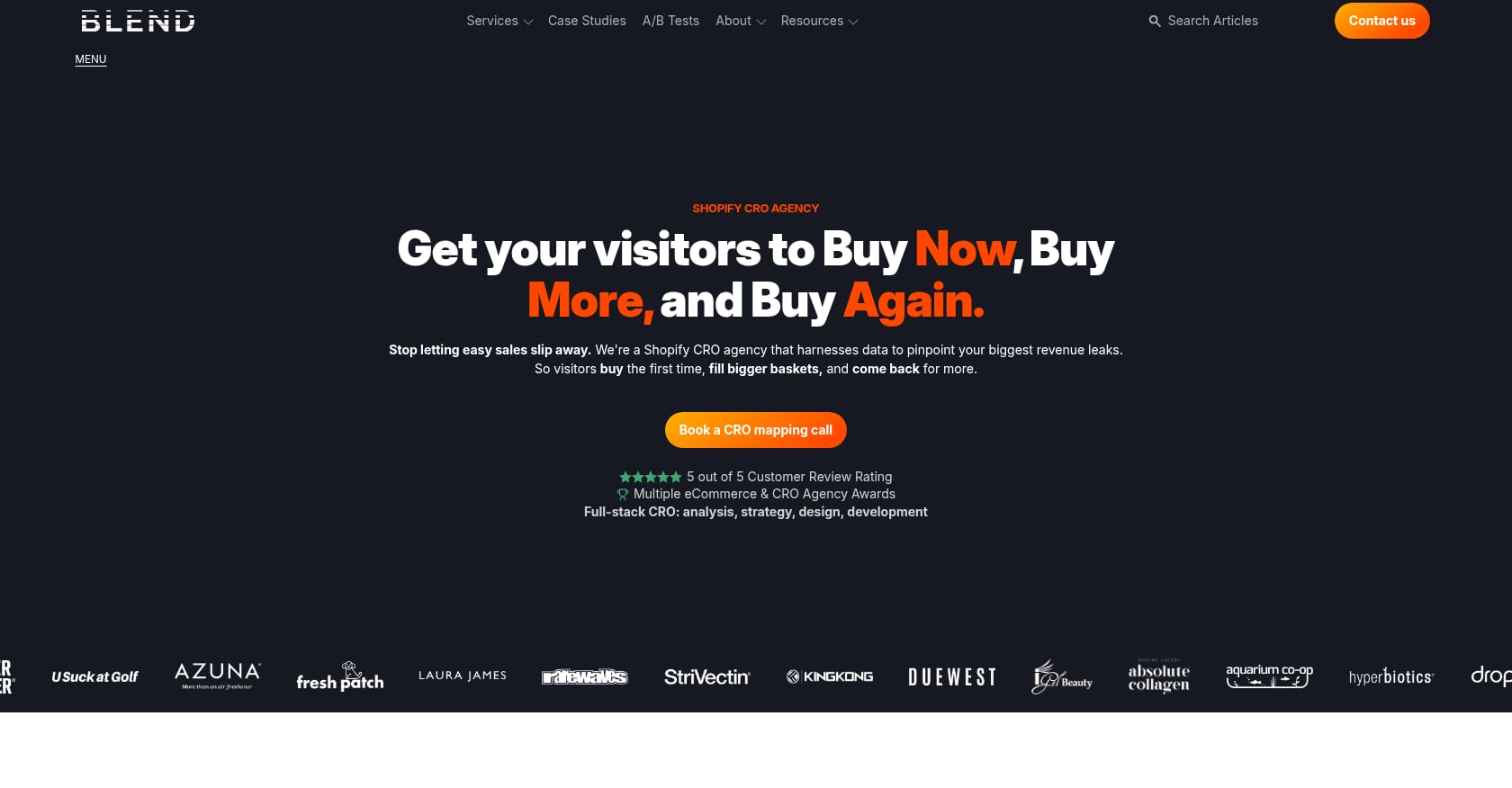
Best for: Shopify-only brands wanting a UK-based CRO partner with design and development capabilities in-house.
Pricing: Depends on store size and depth of work required. Projects typically start with a one-off CRO Audit and Insights Roadmap, followed by ongoing monthly optimisation.
Key features:
- Shopify-focused CRO agency working with established brands that already have traffic and want to increase conversion rate, average order value, and revenue through structured experimentation
- Claims up to +35% repeat purchases and +20% conversion rate improvements for premium brands
- Handles seamless migrations to Shopify Plus alongside CRO work
- In-house design and development means faster test implementation without third-party dependencies
User perspective: One Clutch reviewer reported that after a redesign project, Blend Commerce helped increase sales by 731%, total orders by 635%, and online sessions by 626%.
Tradeoffs:
- Shopify only. No Amazon, no WooCommerce, no multi-marketplace support
- UK-based, which creates time zone challenges for US brands needing real-time collaboration
- Limited public pricing makes comparison difficult
For brands on Shopify looking to improve their checkout experience specifically, our guide on improving Shopify checkout conversion covers the tactical foundations that any CRO partner should be addressing.
7. KlientBoost
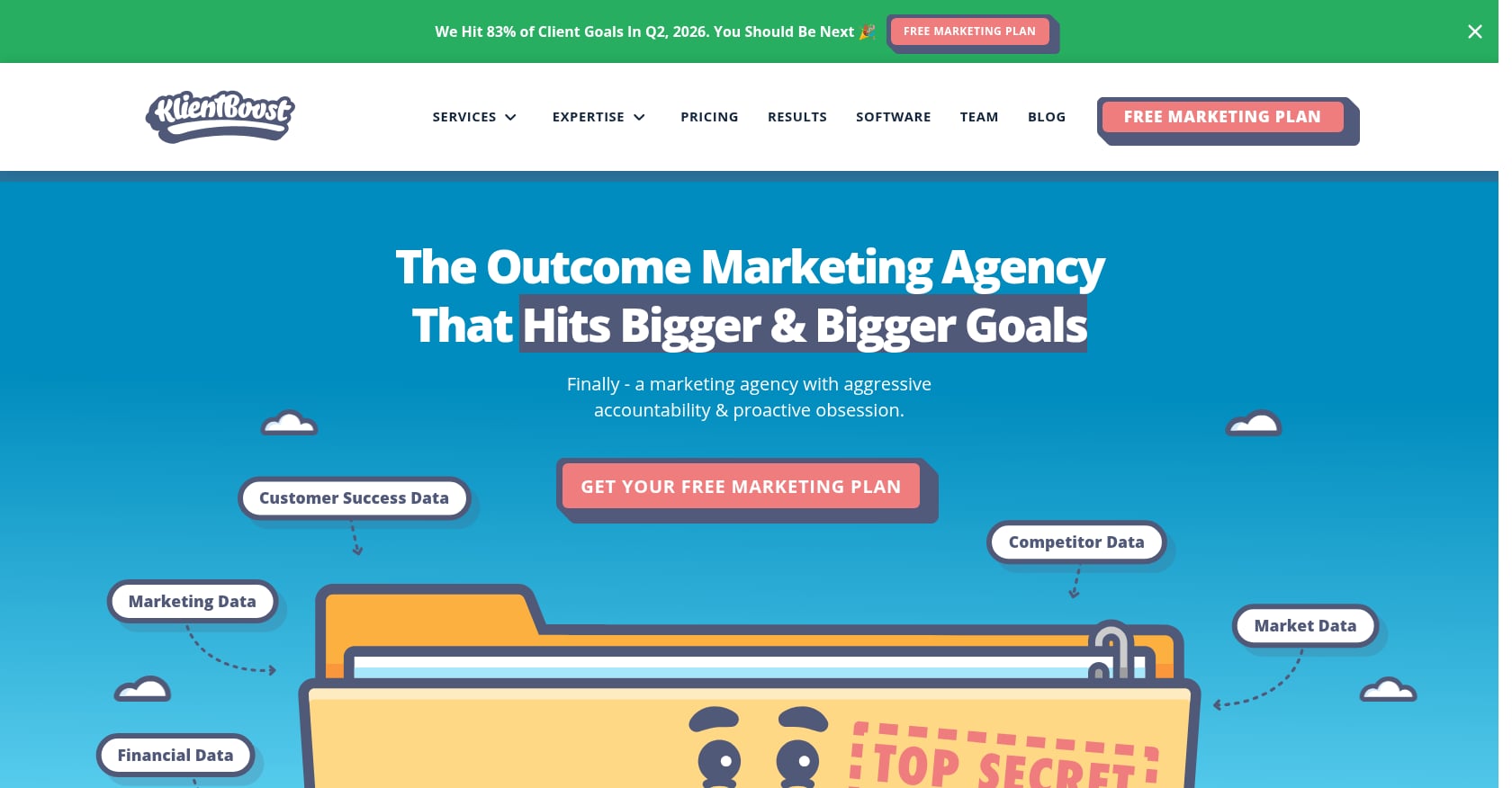
Best for: DTC and SaaS brands wanting CRO bundled with PPC management and creative testing.
Pricing: Base retainer typically starts at $4,000–$6,000/month, with most clients paying more once ad spend thresholds and add-on services are factored in.
Key features:
- Founded in 2015, headquartered in Costa Mesa, California, with 250+ active clients and a team of nearly 100–130 specialists
- Built on the insight that creative and conversion rate optimization drive better results than testing tactics alone
- Integrates CRO with paid media management for a combined approach to acquisition and conversion
- Strong creative testing capabilities across landing pages, ad creative, and on-site elements
User perspective: One G2 reviewer shared that KlientBoost “helped us unlock and scale channels we had nearly written off,” noting their efforts “brought conversions from 1% to well over 5% consistently.”
Tradeoffs:
- The compounding effect of extras means your effective monthly cost is often 20–40% higher than the quoted retainer
- CRO is bundled with PPC, so it’s not ideal if you only need pure conversion optimization without paid media management
- Generalist positioning across DTC and SaaS means less specialized ecommerce depth than agencies like SplitBase or Blend Commerce
8. Conversion Fanatics
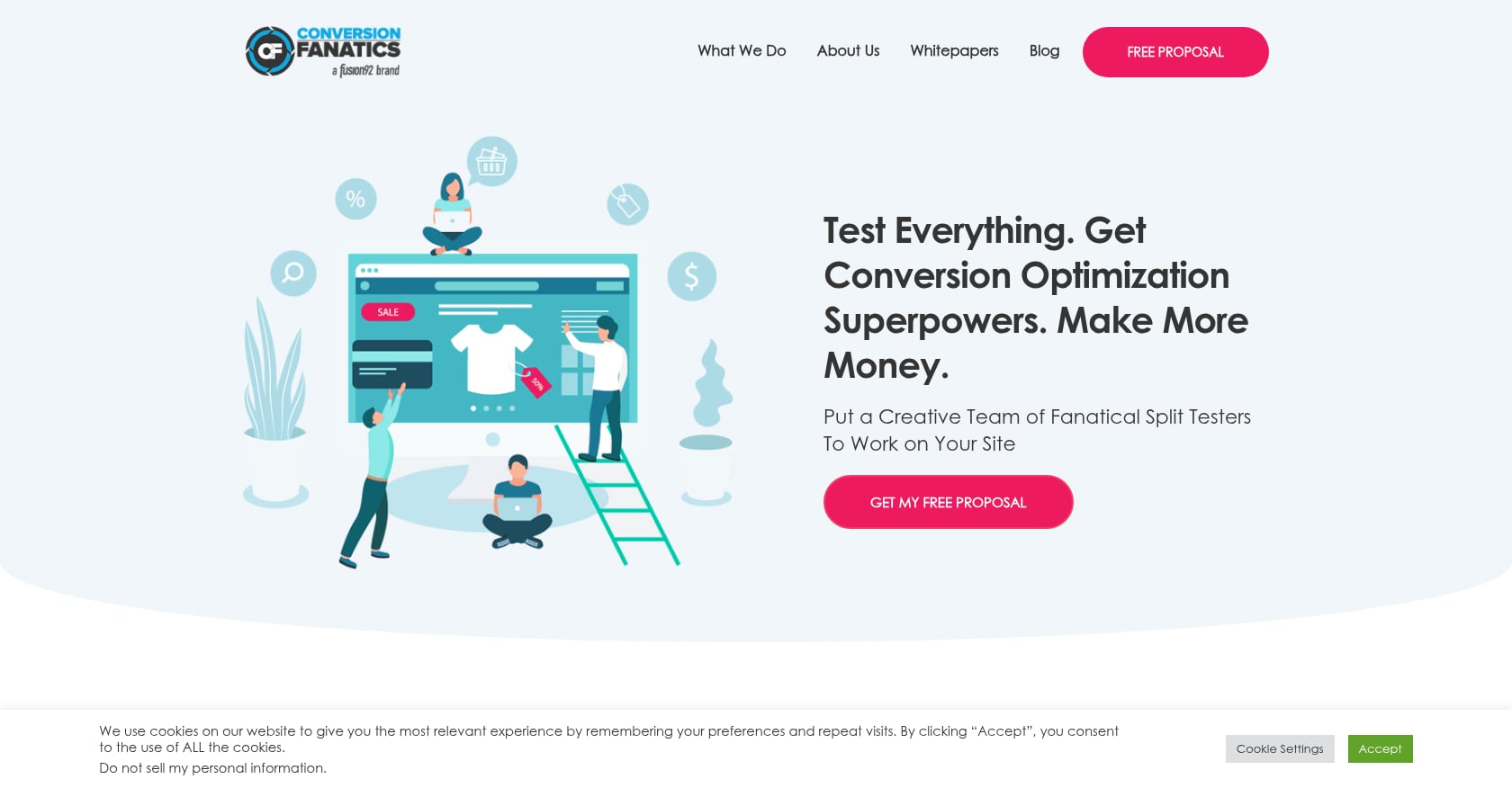
Best for: High-traffic ecommerce stores (Shopify/WooCommerce) needing rapid A/B testing velocity at a mid-tier price point.
Pricing: Mid-tier; positioned as affordable relative to enterprise CRO agencies. Specific rates are not publicly listed.
Key features:
- Since 2014, they’ve assisted over 350 companies with a 46% success rate in experiments, significantly higher than the industry average
- Known for speed and agility, launching dozens of A/B tests quickly to identify incremental wins that stack over time
- Focus on ecommerce-specific optimization rather than B2B or SaaS
- Accessible pricing makes them suitable for startups and mid-market brands
Tradeoffs:
- Less research depth than Invesp or Speero; the approach prioritizes velocity over deep qualitative research
- Limited public information about pricing, methodology framework, and team structure
- The high-velocity approach works best when you already know your biggest friction points; brands needing foundational research may need a more consultative partner
9. Conversion Rate Experts
Best for: Enterprise brands wanting a science-led, methodology-heavy approach to CRO.
Pricing: Premium. Referenced across multiple listicles as a high-end pick for brands with $1M+ revenue. Specific rates are not publicly listed.
Key features:
- Known for their proprietary “System” methodology featuring a deep customer research phase before any testing begins
- Emphasis on understanding customer psychology and decision-making processes
- Long track record across major enterprise clients
- Rigorous, process-heavy approach designed for brands willing to invest time upfront for larger payoffs downstream
Tradeoffs:
- Very high price point limits accessibility to well-funded enterprise brands
- Process-heavy methodology means longer time to first test, which frustrates teams wanting quick wins
- Not positioned as an ecommerce specialist; their methodology applies broadly, which can be an advantage or disadvantage depending on your needs
CRO Agency Pricing: What to Expect in 2026
Pricing is the first thing most buyers want to know, and it’s the thing conversion rate optimisation agencies are most reluctant to share. Here’s what the market actually looks like.
Price Tiers
Entry tier ($2,000–$5,000/month): Agencies starting out in CRO or those with smaller, less specialized teams. Suitable for mid-market brands wanting to dip into testing without major budget commitment. EZCommerce’s D2C EzScale tier (starting at $1,999/month) falls here, with CRO bundled into a broader growth program.
Mid tier ($6,000–$15,000/month): Agencies with established frameworks, dedicated CRO specialists, and a track record of documented results. This is where most serious ecommerce brands land.
Top tier ($16,000–$35,000+/month): Agencies with 7+ years of pure CRO experience, extensive case study libraries, and enterprise-grade processes. Spiralyze ($25,000/month) and Speero (~$16,700/month) sit in this range.
Project-Based Pricing
Not everything requires a retainer. Common project costs include:
- Comprehensive conversion audit: $3,000–$8,000
- Landing page redesign with testing: $10,000–$30,000
- Full funnel optimization: $15,000–$50,000
Convert’s 2025 Agency & Vendor Experimentation Ecosystem Report noted a trend where clients are moving away from retainers toward more flexible, project-based models, particularly in regions experiencing budget cuts. If you’re testing the waters with a new agency, a project-based engagement lets you evaluate their work before committing to monthly fees.
Performance-Based: Proceed with Caution
Performance-based pricing (where the agency only gets paid when conversions improve) sounds attractive. But it can create misaligned incentives. An agency chasing easy, low-impact wins to trigger payment milestones may avoid the harder, higher-impact tests that move your business forward. Ask exactly how “lift” is measured and over what timeframe before signing a performance deal.
For a deeper look at connecting CRO results to actual revenue, our guide on testing checkout offers to increase AOV shows how to tie test outcomes to financial metrics that matter.
Ecommerce Conversion Rate Benchmarks (2026)
Before you evaluate agencies, know where you stand. These benchmarks give you context for what “good” looks like.
Overall ecommerce averages:
- All industries: 2.5–3.0%
- Top 10% of stores: above 4.7%
- Bottom 25%: below 1.0%
Shopify-specific data:
- Average: 1.4%
- Top 20%: above 3.2%
- Top 10%: above 4.7%
- Across 21 Shopify stores generating $417M in combined revenue, the mean conversion rate was 2.16% in Q2 2026
By industry:
- Food & Beverage: 4.5–6.11% (highest)
- Luxury & Jewelry: 0.87–1.19% (lowest)
By device:
- Desktop: 3.74%
- Mobile: 2.29%
That mobile number is critical. Mobile accounts for 85.9% of all ecommerce traffic but converts at barely half the desktop rate. Any CRO agency you hire should have a mobile-first testing approach, not treat mobile as an afterthought. If cart abandonment on mobile is a known issue for your store, these cart abandonment recovery strategies address the most common drop-off points.
One important caveat: benchmarking against global averages is less useful than benchmarking against your specific industry and traffic mix. A 2.5% conversion rate is excellent for luxury jewelry but mediocre for food and beverage. A good CRO agency will contextualize your performance before proposing changes.
Why CRO Fails (and How the Right Agency Avoids It)
Not every CRO engagement produces results. Here are the four most common reasons conversion rate optimisation efforts stall or fail outright.
1. Dirty tracking. If your analytics are broken, your test results are meaningless. Speero has claimed that 90% of analytics setups they encounter are critically flawed. Before running a single A/B test, your GA4 events, GTM containers, and Meta CAPI need to be configured correctly. This is why agencies that set up clean tracking infrastructure before testing deliver more trustworthy results.
2. Not enough traffic. Running A/B tests on a site with 10,000 monthly sessions is like trying to draw statistical conclusions from a sample size of 12. Tests take months to reach significance, and by then, seasonality and other variables have contaminated your data.
3. Optimizing conversion rate at the expense of margin. A CRO agency can boost your conversion rate by 40% with aggressive discounting and free shipping offers. But if your contribution margin drops from 35% to 15%, you’ve lost money. The best agencies tie CRO outcomes to profitability metrics, not just conversion rate in isolation.
4. Agency misalignment. Performance-based agencies may chase quick, easy wins (button color tests, minor copy tweaks) rather than tackling the harder structural problems that drive significant, lasting improvement. Retainer-based agencies with transparent methodology tend to take on the harder challenges because their incentive is long-term retention, not short-term payout triggers.
Frequently Asked Questions
What is a CRO agency?
A conversion rate optimisation agency specializes in increasing the percentage of website visitors who complete a desired action, typically a purchase, sign-up, or lead form submission. They do this through research, A/B testing, UX improvements, and data analysis. Unlike web design agencies, CRO agencies focus specifically on measurable performance improvements validated through testing, not aesthetic redesigns.
How much does a CRO agency cost?
Monthly retainers for CRO agencies in 2026 range from $2,000 to $35,000+. Entry-level agencies charge $2,000–$5,000/month. Mid-tier agencies with established frameworks charge $6,000–$15,000/month. Top-tier agencies with deep experience and enterprise processes charge $16,000–$35,000+. One-off projects like conversion audits typically cost $3,000–$8,000.
How long until a CRO agency delivers results?
Most reputable agencies set expectations for initial test results within 30–90 days. However, meaningful, compounding improvements usually take 3–6 months of continuous testing. Be wary of agencies promising transformative results in under 30 days unless they have a very specific, data-backed approach (like Spiralyze’s predictive model).
Should I choose a Shopify-specific CRO agency or a platform-agnostic one?
It depends on your tech stack. If you sell exclusively on Shopify, a Shopify-specialist like Blend Commerce or SplitBase will have deeper platform knowledge. If you sell across Amazon, Shopify, and other channels, a platform-agnostic agency or one that explicitly covers multiple channels (like EZCommerce) will serve you better. The worst outcome is hiring a Shopify CRO agency when half your revenue comes from Amazon.
Can a CRO agency help with Amazon?
Yes, though most don’t. Amazon product detail page optimization, A+ Content testing, main image optimization, and listing copy refinement are all forms of conversion rate optimisation. Most CRO agency lists only cover Shopify, which is why Amazon sellers often fall through the cracks. Look for agencies that explicitly include Amazon listing conversion work in their service offering.
What’s a good ecommerce conversion rate?
It varies by industry. The overall ecommerce average is 2.5–3.0%. Food & Beverage stores average 4.5–6.1%, while Luxury & Jewelry averages under 1.2%. On Shopify specifically, stores above 3.2% are in the top 20%. Rather than targeting an arbitrary number, aim to outperform your industry benchmark and improve quarter over quarter.
What should I ask a CRO agency before hiring them?
Ask five questions: (1) What is your testing framework called and what are its steps? (2) How do you determine sample sizes and test duration? (3) Can you share named clients with specific conversion metrics? (4) Who on your team will execute my tests day to day? (5) What exactly is included in your retainer, and what costs extra? Vague answers to any of these should give you pause.
Do I need to fix my analytics before hiring a CRO agency?
Absolutely. If your GA4 events aren’t firing correctly, your conversion tracking is misconfigured, or your Meta CAPI setup is incomplete, any A/B test results will be unreliable. Some agencies (including EZCommerce) handle tracking setup as part of their onboarding. Others assume your data layer is already clean. Clarify this before signing.
Finding the Right CRO Partner
Choosing among conversion rate optimisation agencies comes down to three questions: What channels do you sell on? How much traffic do you have? And what budget can you commit?
If you’re an enterprise brand with massive traffic and budget for standalone experimentation, Invesp, Spiralyze, or Speero will serve you well. If you’re a DTC luxury brand doing $10M+ in revenue, SplitBase is purpose-built for you. If you want CRO bundled with PPC, KlientBoost offers that combination.
But if you sell on Amazon and D2C, want CRO tied to actual profitability, and prefer one team managing traffic, conversion, inventory, and margin together, EZCommerce’s unified approach fills a gap that pure-play CRO agencies simply don’t address.
Ready to find your conversion gaps? Get a free brand audit with a detailed scorecard, quick wins, and a 90-day growth plan, delivered in 5–7 business days with no obligation.